University of California Press

About the Book

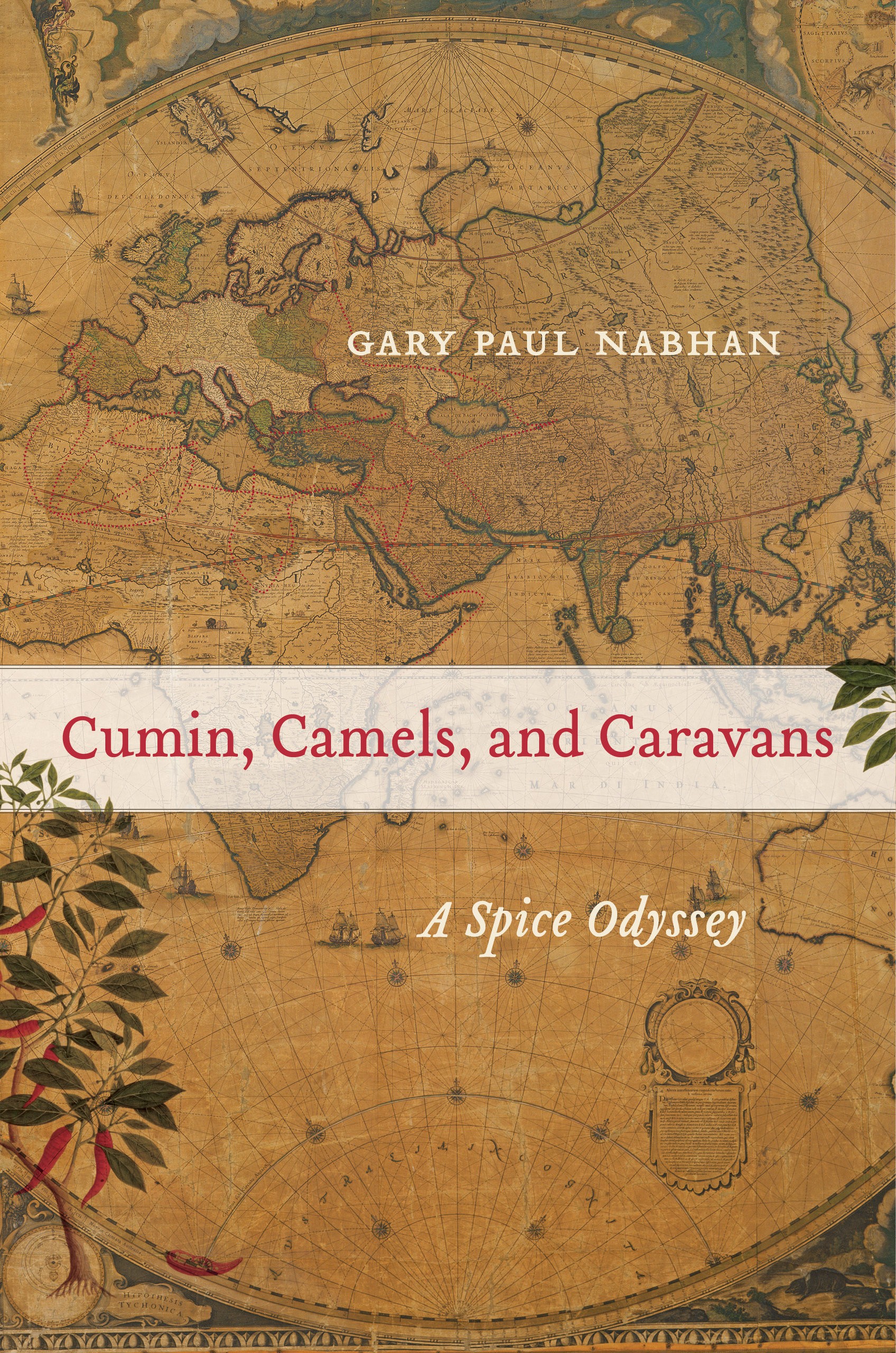
Gary Paul Nabhan takes the reader on a vivid and far-ranging journey across time and space in this fascinating look at the relationship between the spice trade and culinary imperialism. Drawing on his own family’s history as spice traders, as well as travel narratives, historical accounts, and his expertise as an ethnobotanist, Nabhan describes the critical roles that Semitic peoples and desert floras had in setting the stage for globalized spice trade.

Traveling along four prominent trade routes—the Silk Road, the Frankincense Trail, the Spice Route, and the Camino Real (for chiles and chocolate)—Nabhan follows the caravans of itinerant spice merchants from the frankincense-gathering grounds and ancient harbors of the Arabian Peninsula to the port of Zayton on the China Sea to Santa Fe in the southwest United States. His stories, recipes, and linguistic analyses of cultural diffusion routes reveal the extent to which aromatics such as cumin, cinnamon, saffron, and peppers became adopted worldwide as signature ingredients of diverse cuisines. Cumin, Camels, and Caravans demonstrates that two particular desert cultures often depicted in constant conflict—Arabs and Jews—have spent much of their history collaborating in the spice trade and suggests how a more virtuous multicultural globalized society may be achieved in the future.


About the Author

Gary Paul Nabhan is an Ecumenical Franciscan Brother, MacArthur "genius" award winner, and ethnobotanist of Arab-American descent. His food and farming books include Food from the Radical Center, Where Our Food Comes From, and the forthcoming Jesus for Farmers and Fishers.

Table of Contents

List of Illustrations
List of Recipes
List of Spice Boxes

Introduction: The Origin of “Species”
1. Aromas Emanating from the Driest of Places
2. Caravans Leaving Arabia Felix
3. Uncovering Hidden Outposts in the Desert
4. Omanis Rocking the Cradle of Civilization
5. Mecca and the Migrations of Muslim and Jewish Traders
6. Merging the Spice Routes with the Silk Roads
7. The Flourishing of Cross-Cultural Collaboration in Iberia 
8. The Crumbling of Convivencia and the Rise of Transnational Guilds
9. Building Bridges between Continents and Cultures
10. Navigating the Maritime Silk Roads from China to Africa
11. Vasco da Gama Mastering the Game of Globalization
12. Crossing the Drawbridge over the Eastern Ocean

Epilogue: Culinary Imperialism and Its Alternatives
Acknowledgments
Notes
Index

Reviews

"Richly embroidered with detail, Cumin, Camels, and Caravans by scholar Gary Paul Nabhan is part history, part geography, part cookbook, and part travel memoir. . . . Interspersed with recipes from various stops on historical spice routes, Nabhan discusses the botany, linguistic history, and trade history of each substance, but far from being dry accounts, they bring the wonder of many ingredients we now view as commonplace into focus; Nabhan's painstaking research has not eclipsed an evident natural knack for storytelling."
Saveur
"Nabhan is the ideal travelling companion. With an ancestry that stretches back to the spice-trading Nabheni tribe of Oman, Nabhan is by profession an ethnobotanist and food writer with a clutch of culinary history books under his belt. And he wears his erudition lightly. Although the book is referenced like an academic tome, it reads like a detective story – albeit one with generous pinches of exotic smells and alluring flavours thrown in.  Spiced locusts, anyone?"
History Today
"Heady historical and cultural study of ancient trade routes. . . . Nabhan adds pungent pinches of botany and gastronomy."
Nature
"Gary Paul Nabhan, a food scholar and prolific author, is the guide on a journey that also travels through subjects as diverse as botany and archaeology. Even when following well-worn paths, he is never a dull host. . . . While the book is ostensibly about spices, what holds it together is a deeper sense of distance from nature and the deep past, a force that continues to impel pilgrims, travellers and even foodies towards distant and exotic places."
Times Higher Education
"...a worthwhile read. Nabhan achieved what he set out to in this book, and brings to light a cultural historical geography of spices and people that has not, to my knowledge, been pulled together in quite the way he has done before."
AAG Review of Books
"Gary Paul Nabhan weaves a fascinating story."

Santa Fe New Mexican
"This book is a singular achievement . . . . A most absorbing book and highly recommended."
Chicago Botanic Garden
“Anyone who has traveled ancient routes, or dreamed of doing so, will find deep satisfaction in Cumin, Camels and Caravans: A Spice Odyssey."
Forbes
"Cumin, Camels, and Caravans is epic in its scope, spanning continents and millennia and exploring how the emergence and development of the spice trade set in motion the process of globalization. Gary Nabhan is a master storyteller with a broad, multidisciplinary perspective. He provides vivid tales of historical figures and his own travels along the ancient spice routes, fascinating observations of cross-cultural linguistic and culinary parallels, and reflections on how the spice trade influenced his own family's migrations. Anyone interested in food and history will love this book." —Sandor Ellix Katz, author of The Art of Fermentation and Wild Fermentation

"Gary Nabhan's journeys along ancient trade routes of the Old and New World have resulted in a remarkable and evocative book. He has plenty to tell us about the real, distant origins of globalization and even more about the peoples who make their living from these rare, costly, heady, health-giving aromas. Nabhan knows this trade intimately, and he brings it to life: I could smell the incense, I could taste the chocolate." —Andrew Dalby, author of Dangerous Tastes: The Story of Spices

"On the face of it, in this travel memoir braided with history, Nabhan seems focused on the spice trade, but in fact he’s looking at the origins of globalization: a fascinating read." —Tamim Ansary, author of Destiny Disrupted: A History of the World through Islamic Eyes

"As a chef, I take pride in my spice cabinet. Those spices enable me to travel the world via recipes. So I was fascinated by Gary Nabhan's Cumin, Camels, and Caravans, which traces his family's history and that of the complex trade and dissemination of spices ad aromatics over the centuries. I am grateful for those ancient caravans that traveled over land and sea." —Joyce Goldstein, chef, culinary expert, and author of numerous books, including Inside the California Food Revolution and The Mediterranean Kitchen
"An intensely personal and fascinating retelling of the spice trade from the Arab point of view that bubbles over with infectious enthusiasm." —Michael Krondl, food writer, culinary historian, and author of several books, including The Taste of Conquest: The Rise and Fall of the Three Great Cities of Spice

Awards

  • 2014 Gourmand Award for Best Arab Cuisine, Gourmand World Cookbook Awards