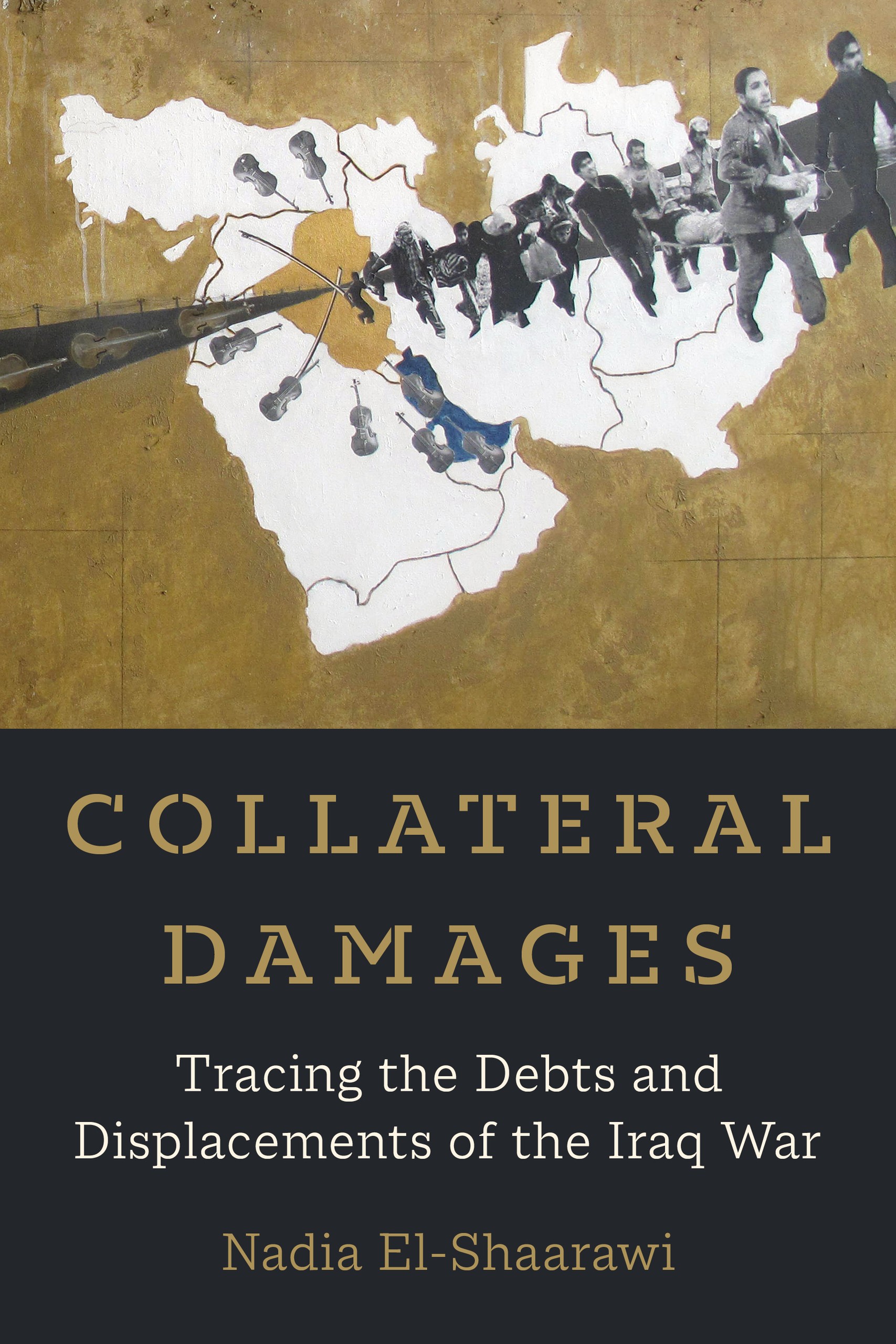
Collateral Damages
About the Author
Table of Contents
Acknowledgments
Note on Transliteration
Introduction: Departure
1. "Bad History": Imperial Unknowing and the Iraq War
2. War Archive: Telling and Listening to War Stories
3. Living in the Transit City: Seeking Refuge, Refusing Refugeeness
4. Negotiating Humanitarian "Solutions" to Displacement: Iraqis' Experiences of the Refugee Resettlement Process in Cairo
5. Allies and Enemies: Resettlement and the Conditionality of Iraqis' Relations with US Empire
Conclusion: Arrival
Notes
References
Index
Reviews
— Pianeta Libri news“Collateral Damages is not a polemic but an act of witness. . . . Clear, courageous, and profoundly humane, it stands as one of the few works that give the Iraq War’s survivors back their voice and their dignity”
— Developing Economies“A compelling and theoretically rich ethnographic study of Iraqi refugees who were displaced to Egypt in the aftermath of the 2003 US invasion and occupation of Iraq.”
— Review of Middle East Studies"El-Shaarawi. . . . illuminate[s] dimensions of the Iraq War often absent from myopic diplomatic and military histories. By tracing how refugees navigate humanitarian institutions, El-Shaarawi persuasively demonstrates how the effects of imperial violence extend long after the cessation of hostilities. . . . Collateral Damages offers far more than a compelling retrospective account of the Iraq War—it illuminates a recurring pattern in imperial interventions."
— Medical Anthropology Quarterly“A timely and powerful ethnography. . . . an incisive and indispensable examination of the entangled effects of imperial and humanitarian interventions.”
"This beautifully written book starts with an irony that has been rendered unknowable: the United States resettles and offers humanitarian aid to those displaced by its own imperial violence. This is conveyed as generosity rather than as a debt to those who have been displaced. El-Shaarawi's deeply insightful, nuanced ethnography of Iraqi refugees waiting for resettlement expands both temporal and epistemological frames to show the connections between the war on Iraq and humanitarianism—a tying together that renders visible US complicity and responsibility. A must-read from a leading scholar of the turn to temporality in migration studies."—Miriam Ticktin, Professor of Anthropology, and Director of the Center for Place, Culture and Politics (CPCP), CUNY Graduate Center
"Collateral Damages is a beautifully crafted ethnography that is exceptional in its breadth of scholarly insight. It depicts with great care the prismatic complexity of temporal experience and the psychic investment structuring Iraqi migrant experiences in Egypt. As Iraqis wait indefinitely for resettlement, life projects are suspended. El-Sharaawi's exploration of this experience of existential suspension represents a timely and important contribution to the study of displacement.
El-Shaarawi's central structuring concept of imperial unknowing is both brilliant and persuasive. It's an intrinsically interesting move to think about the way unknowing has been mobilized as a form of power and privilege in the context of US imperial politics, and to examine what crests into view when one attends to the largely unexamined alignment of power and 'ignorance.' Collateral Damages will secure El-Sharaawi's reputation as a leading scholar of the Iraqi refugee experience and the affective afterlives of empire that have arisen through the intertwinement of US-led military and humanitarian intervention in the Middle East. The judiciousness and fineness of sensibility she shows throughout is in fact a precondition of serious ethnographic work on Iraqi refugees, whose material and aspirational lives have tended to be flattened into moral counters in a political and rhetorical game."—Diana Allan, Associate Professor, and Canada Research Chair in the Anthropology of Living Archives, McGill University
"This is a book I was waiting for without knowing it. A research-based work that reveals the intersection of imperial warfare, mass displacement, and humanitarianism. Centered around the concept of imperial unknowing, Collateral Damages exposes how epistemological practices are weaponized to obscure the imperial construction of the distorted relationship between barbarism and civilization. A valuable contribution to academia and beyond."—Shahram Khosravi, Professor, Stockholm University