University of California Press

About the Book

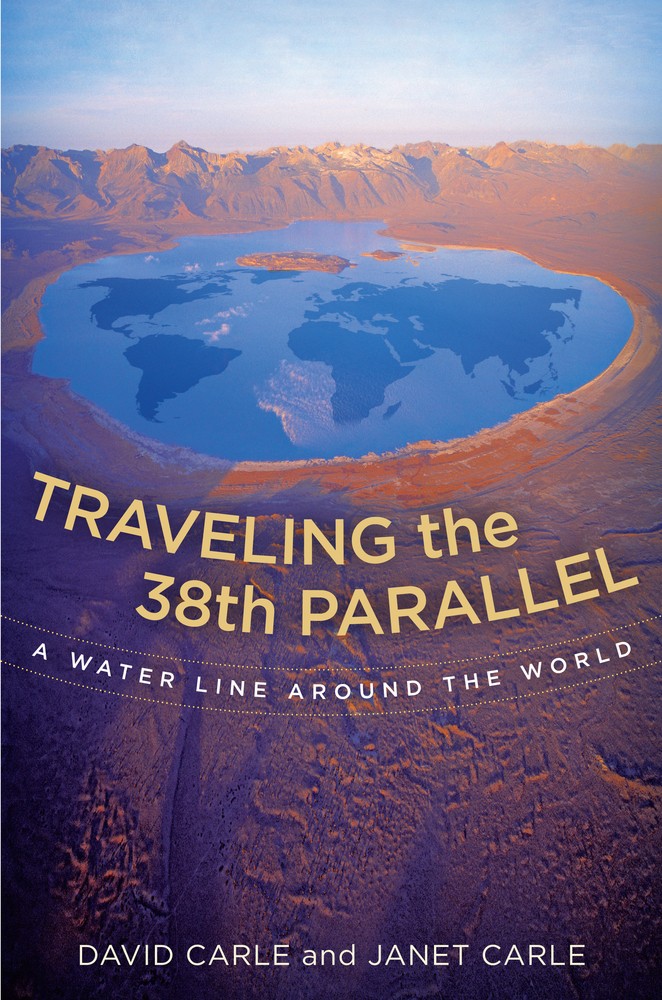
Between extremes of climate farther north and south, the 38th North parallel line marks a temperate, middle latitude where human societies have thrived since the beginning of civilization. It divides North and South Korea, passes through Athens and San Francisco, and bisects Mono Lake in the eastern Sierra Nevada, where authors David and Janet Carle make their home. Former park rangers, the authors set out on an around-the-world journey in search of water-related environmental and cultural intersections along the 38th parallel. This book is a chronicle of their adventures as they meet people confronting challenges in water supply, pollution, wetlands loss, and habitat protection. At the heart of the narrative are the riveting stories of the passionate individuals—scientists, educators, and local activists—who are struggling to preserve some of the world's most amazing, yet threatened, landscapes.

Traveling largely outside of cities, away from well-beaten tourist tracks, the authors cross Japan, Korea, China, Turkmenistan, Turkey, Greece, Sicily, Spain, Portugal, the Azores Islands, and the United States—from Chesapeake Bay to San Francisco Bay. The stories they gather provide stark contrasts as well as reaffirming similarities across diverse cultures. Generously illustrated with maps and photos, Traveling the 38th Parallel documents devastating environmental losses but also inspiring gains made through the efforts of dedicated individuals working against the odds to protect these fragile places.

About the Author

David and Janet Carle were state park rangers at Mono Lake Tufa State Reserve for twenty years and have taught at Cerro Coso Community College in Mammoth Lakes. Janet is the editor of the California State Park Rangers Association journal, The Wave. David is the author of numerous books including Introduction to Earth, Soil and Land in California, Introduction to Water in California, Introduction to Fire in California, and Introduction to Air in California (all by UC Press).

Table of Contents


Introduction: Parallel Universe 38° North

Part I. Asia

The Four Rivers “Restoration” Project
Ecological Recovery behind Barbed Wire
China’s Yellow River Delta
The South-North Water Transfer Project
National Parks of Ningxia
Up the Yellow River to Lanzhou’s Green Camel Bell
Qinghai—Blue Lake of the Tibetan Plateau
Hotan to Kashgar on the Southern Silk Road
The Edge of China and Turkmenistan
Hasankeyf in Peril on the Tigris River
Fairy Chimneys, Tuz Golu, Travertine, and a City That Lost Its Port

Part II. Europe

Greek Islands, Athens, and the “Navel of the Earth”
Saving Raptors and Water in Sicily
Spain’s Coastal Lagoons, Water for Growth, and Iberian Lynx
Portugal’s Transported Town, a Solar Donkey, and the Azores

Part III. United States

Chesapeake Bay Watershed Education
The Rappahannock River and Mattawoman Creek
Mountaintop Removal Coal Mines in West Virginia
Midwestern Rivers and the Population Center of the United States
Seagulls in Kansas and the Santa Fe Trail
Mining the Ogallala Aquifer
Colorado, the Headwaters State
Colorado River Cleanup and Groundwater for Las Vegas

Part IV. California: A Water Line to the Pacific

Mono Lake to the Sierra Crest
Grand Canyon of the Tuolumne to Hetch Hetchy
Friends of the River and the New Melones Reservoir
The Sacramento–San Joaquin Delta
Strait to the Bay
Point Reyes and the Pacific Coast

Part V. Renewal and Recovery

Recovery on the Tsunami Coast
It Takes a Village to Save the Toki
We Are Bodies of Water

Acknowledgments
Bibliography
Index

Reviews

“A lucid, well-written book that moves the reader from the salty shores of Mono Lake to the demilitarized zone between North and South Korea with equal ease. It reads more like an adventure novel than a non-fiction travel book.”
Mammoth Times
"Explores the faultlines of water shortage, pollution and environment and the human stories that emerge out of them, beyond the news headlines. An ode to fragile places and the people trying to rescue them."
Skift
"The [authors'] stories are inspiring, sometimes heartbreaking, and should whet the appetite for more information about the history and environment of the areas. . . . Recommended."
CHOICE
“David and Janet Carle illuminate an environmental discussion on waterways and wetlands with accounts of their travel across the Northern Hemisphere. They spent twenty years as park rangers at Mono Lake Tufa State Reserve in California, and the park’s location on the thirty-eighth parallel helped inspire the clever theme of their global adventure. . . . The authors acknowledge the complexity of these issues while also recognizing the many like-minded people around the world who are working to address the issues in meaningful and sustainable ways."
Foreword Reviews
"Beyond [its] informative value, Traveling the 38th Parallel [is] very much [a] tribute to the joys of travel and the richness of learning firsthand from place. Something like pressing your nose against the glass of an all-you-can-eat buffet —you’ll finish with a longing to get your feet wet, and push away from shore."  —Sandy M. Bonny, University of Saskatchewan

"The 38th Parallel is a compelling read with wonderful tension between the environmental problems- the true reason for their journey- and the extraordinary sights they encounter following the 38th parallel. Pushed off the typical tourist path, David and Janet Carle's striking account of their journey addresses larger issues of deforestation, pollution and degradation of the land." —Dean MacCannell, author of The Tourist and The Ethics of Sightseeing

"David and Janet Carle's journey along the 38th parallel provides a unique approach to exploring the world's struggle to maintain water resources. Their exploration of diverse cultures and landscapes combines wonderfully with their well-considered examination of water issues." —Robin Grossinger, Senior Scientist at the San Francisco Estuary Institute

“David and Janet Carle’s journey along the 38th parallel turned into something quite different- an exploration of diverse global environments, of exploitation and heroic efforts at renewal with long-term planning for recovery. This is a treasure of a book that provides both hope and food for thought. Everyone who cares about the future of our environment should read this remarkable volume.”—Brian Fagan, author of Elixir: A History of Humans and Water and Emeritus Professor of Anthropology, University of California, Santa Barbara

“Regardless of our differences, all humans share an utter dependency on water. We will run out of oil eventually, but if we allow reason to prevail, we need not run out of water. This beautiful book both reveals the threat to our water resources and gives us hope. Read it for your sake and your children’s sake.” —James Lawrence Powell, author of Dead Pool