University of California Press
Publishing Services

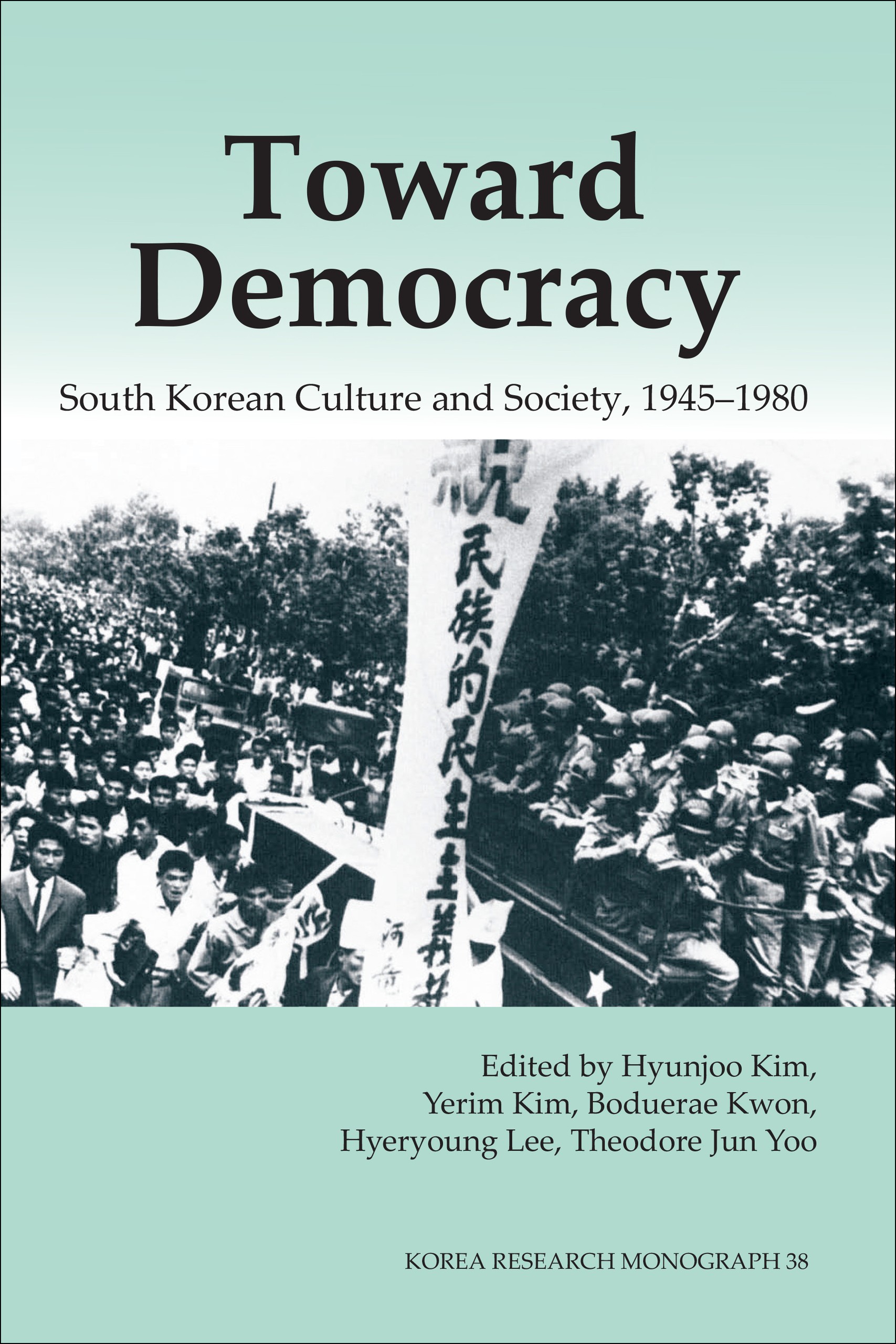
Toward Democracy

South Korean Culture and Society, 1945–1980

by Hyunjoo Kim (Author), Yerim Kim (Author), Boduerae Kwon (Author), Hyeryoung Lee (Author), Theodore Jun Yoo (Author)
Price: $35.00 / £30.00
Publication Date: Jul 2020
Publisher:
Institute of East Asian Studies, University of California Berkeley
Imprint: Institute of East Asian Studies, University of California Berkeley
Title Details:
Rights: World
Pages: 364
ISBN: 9781557291905
Trim Size: 6 x 9
Series:
  • Korea Research Monograph

About the Book

This volume brings together translated essays by fourteen established and emerging South Korean scholars. Using approaches from sociology, political science, history, and literary and cultural studies, the authors offer innovative and nuanced analyses of a wide range of topics—from refugee displacement to street politics, from anti-communism and democracy to militarization—and discuss the links between cultural productions and their sociohistorical contexts. Divided into five parts, the collection begins with the national division in 1945 and devastating civil war and concludes with the May 18 Democratic Uprising in 1980.

Table of Contents

Acknowledgments vii
Preface ix
Theodore Jun Yoo
 Introduction: What Is South Korea? xiii
 John Lie
 PART I: LIBERATION AND THE POLITICS OF THE PEOPLE
 1. The State as Betrayal and People as Refugees: The Politics of Return 3
 Yerim Kim
 2. Street Politics and the Production of Representations 15
 Cheon Junghwan
 3. Days and Nights of Taking up Arms: Guns, Young Men, and Liberation 40
 Hyeryoung Lee
 PART II: THE COLD WAR’S HOT WAR: CONFLICT, RECONSTRUCTION, AND FREEDOM
 4. The State as God: North and South Korean Occupation and Mobilization Policies During the Korean War 67
 Kim Dong-choon
 5. Morals and Liberal Democracy After the Korean War 92
 Lee Bong-beom
 6. Traveling in Asia: The (Im)possibility of Intraregional Traffic 106
 Chang Se-jin
 PART III: ARTICULATIONS OF RESISTANCE AND NETWORKS
 7. The Intellectual Landscape of 1964: Anti-communism, Nationalism, Democracy, Liberalism, and Developmentalism 131
 Kim Kun Woo
 8. The April Revolution and the May Coup: The Topos of Liberty and Bread 149
 Boduerae Kwon
 PART IV: BODY, SPACE, AND AFFECTIVE DEMOCRACY
 9. The April Uprising of the “Youth Generation” and the Rituals of Resistance 177
 Kim Miran
 10. A Spatial Sociology of the April 19 Uprising and May 16 Coup 192
 Kim Baek Yung
 11. Those Deprived in 1971: The Housing Protests 217
 Kim Won
 PART V: FROM DECADENCE TO REVOLT: FISSURES IN THE STATE
 12. Hostess Movies and the Hypernationalization Project of the Mobilization Regime 241
 Yoo Sun Young
 13. The Boom in Nonelite Writings and the Expansion of the Literary Field 258
 Kim Sunghwan
 14. Counter-Violence and Anti-Violence: The May 18 Armed Struggle and Social Movements of the 1980s 272
 Kim Jung Han
 Afterword 293
 Bruce Cumings
 Contributors 297
 Chronology 299
 Index 31
Reviews

“Toward Democracy is a timely and necessary intervention from scholars at the epicenter of one of the most vibrant grassroots democracies of our time. In the contemporary global crisis of liberalism, Toward Democracy upends any illusion of Western ‘origins’ of democracy to highlight the hard-won struggles for liberty with justice in South Korea. With first-rate scholarship authored and translated by leading and rising scholars in multiple fields, this is an outstanding collection of collective labor.”—Suzy Kim, Rutgers University

“For a deep-dive into the cultural history behind the politics of resistance in South Korea, look no further. Gathered in a single volume and supplemented by contributions in sociology, media studies, and architectural history, these essays by leading scholars of Korean literature offer illuminating perspectives on Korea’s enduring struggle for democracy that are both innovative and consequential.”—Youngju Ryu, University of Michigan

“Toward Democracy captures all of the drama of Korea’s seven-decade struggle for democracy while posing deep intellectual questions. This multidisciplinary volume is a must-read for anyone interested in comparative democracy around the world.”—Andre Schmid, University of Toronto