University of California Press

About the Book

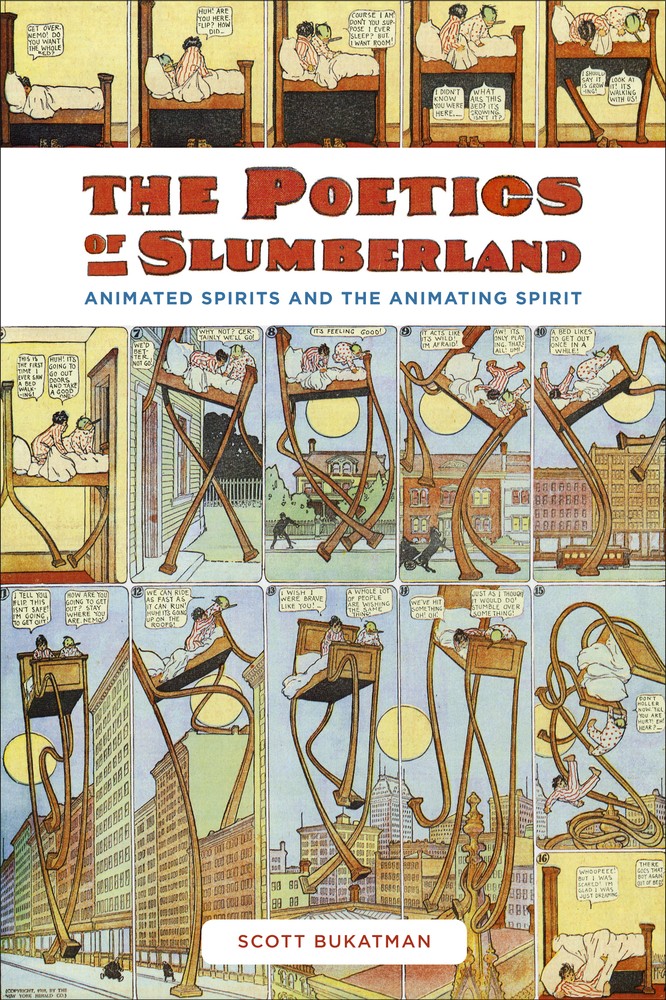
In The Poetics of Slumberland, Scott Bukatman celebrates play, plasmatic possibility, and the life of images in cartoons, comics, and cinema. Bukatman begins with Winsor McCay’s Little Nemo in Slumberland to explore how and why the emerging media of comics and cartoons brilliantly captured a playful, rebellious energy characterized by hyperbolic emotion, physicality, and imagination. The book broadens to consider similar “animated” behaviors in seemingly disparate media—films about Jackson Pollock, Pablo Picasso, and Vincent van Gogh; the musical My Fair Lady and the story of Frankenstein; the slapstick comedies of Jerry Lewis; and contemporary comic superheroes—drawing them all together as the purveyors of embodied utopias of disorder.

About the Author

Scott Bukatman is Professor of Film and Media Studies at Stanford University. He is the author of many books, including Terminal Identity and, most recently, Matters of Gravity: Special Effects and Supermen in the Twentieth Century.

Table of Contents

List of Illustrations
Appreciations

Introduction: The Lively, the Playful, and the Animated
1. Drawn and Disorderly
2. The Motionless Voyage of Little Nemo
3. Labor and Anima
4. Disobedient Machines
5. Labor and Animatedness
6. Playing Superheroes

Notes
Bibliography
Index

Reviews

“Slipping comfortably into Bukatman's book, one is dreamily transported to utopian worlds where merry madcap disorder rules. Beginning with the advent of modernity in the surreal comic strips of Winsor McCay and stretching into the superhuman comics of heroes like Plastic Man and Superman (with a really cool cape), the author re-enchants the labor of creative artistry with the spirit of anima. . . . The lavishly illustrated book is delightfully Chestertonian, clapping its hands in glee over the unruly energy and plasmatic possibilities of the Pygmalion myth drawn into the imaginations of playful artists and their exhilaratingly disruptive arts. . . .Bukatman shows the marvelous animated poetics of visual media. . . . Essential.”
Choice
"Thanks to Bukatman’s prose (a blend of rich textual analysis, a deft knowledge of theories ranging from play to phenomenology, and humour—here is a book about comics that is often comical!)—and a beautiful collection of colour and black and white reproductions of comic and film art, our scholarly community now benefits from an elaboration of both the practice of comic book consumption and the ties that bind American comics and animation."
Studies in Comics
"...an exceptional analysis of the nature of the animated and the animating (in the broadest sense of these terms) as they arise in twentieth- (and twenty-first-) century narrative media. Anyone who is interested in comics and animation, or in the role played by notions of life, energy, and plasticity in art more generally, will find much that is useful, novel, and insightful in Bukatman’s study."
caa.reviews
“In praise of animation and play, The Poetics of Slumberland is what we rarely find—an inspiring book exploring the elastic pleasures of the imagination.”—Alexander Nemerov, author of Acting in the Night: Macbeth and the Places of the Civil War

The Poetics of Slumberland continues Scott Bukatman's fascination with the vertiginous mapping of modernity from the early twentieth century to the present, here with emphasis on the relationship of the artist/animator to his own potentially autonomous and disobedient creations, which often demand a ‘life of their own.’ Never pedantic, always vibrant, and often downright funny, Bukatman's essays range across artists, art forms, and genres in a work that is as imaginative and seriously playful as its overarching theme.”—Vivian Sobchack, author of Carnal Thoughts: Embodiment and Moving Image Culture

“Bodies which expand and stretch through animation and special effects, within worlds subjected to topsy-turvy perspectives and kaleidoscopic optics. . . . Bukatman synthesizes a view of an American popular culture of comics, musical numbers, science fiction fantasies, Jerry Lewis’s convulsions, and superhero transcendence with considerations of the sublime, abstract expressionism, the phenomenology of the body, and avant-garde cinema—and makes us believe it! Rarely has any critic caught the pulse of American dreams so vividly and with equal parts exhilaration and vertigo."—Tom Gunning, author of D. W. Griffith and the Origins of American Narrative Film: The Early Years at Biograph