University of California Press

About the Book

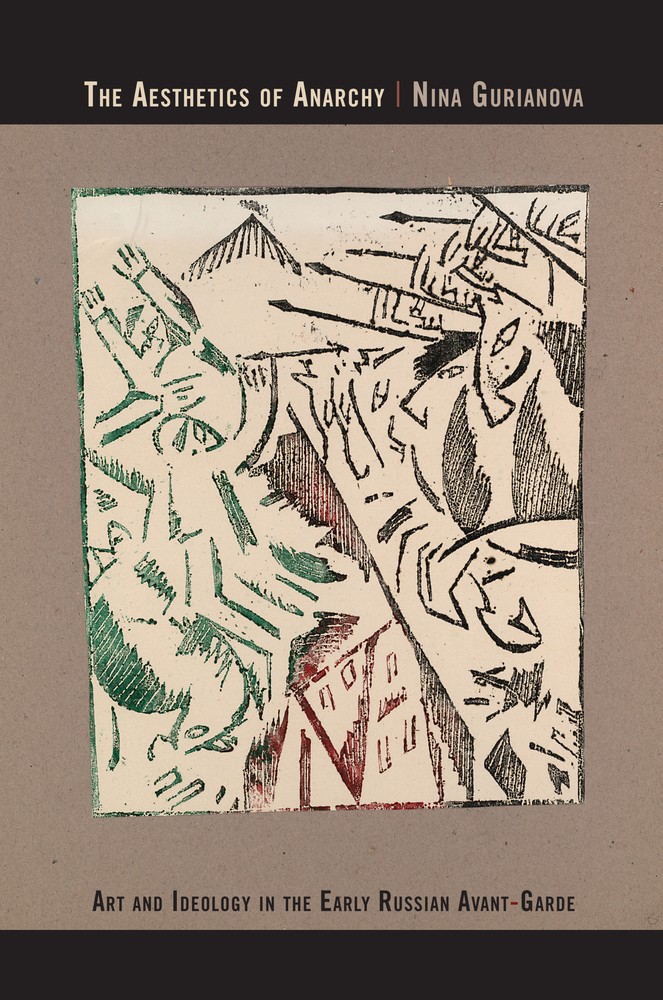
In this groundbreaking study, Nina Gurianova identifies the early Russian avant-garde (1910-1918) as a distinctive movement in its own right and not a preliminary stage to the Constructivism of the 1920s. Gurianova identifies what she terms an “aesthetics of anarchy”—art-making without rules—that greatly influenced early twentieth-century modernists. Setting the early Russian avant-garde movement firmly within a broader European context, Gurianova draws on a wealth of primary and archival sources by individual writers and artists, Russian theorists, theorizing artists, and German philosophers. Unlike the post-revolutionary avant-garde, which sought to describe the position of the artist in the new social hierarchy, the early Russian avant-garde struggled to overcome the boundaries defining art and to bridge the traditional gap between artist and audience. As it explores the aesthetics embraced by the movement, the book shows how artists transformed literary, theatrical, and performance practices, eroding the traditional boundaries of the visual arts and challenging the conventions of their day.

About the Author

Nina Gurianova is Associate Professor of Slavic Languages and Literatures at Northwestern University. She is the author of Exploring Color: Olga Rozanova and Early Russian Avant-Garde.

Table of Contents

Introduction. The Russian Avant-Garde and the Aesthetics of Anarchy

Part I. Movements and Ideas
1. The Aesthetics of Anarchy: Definitions
2. Ideas: Bakunin, Tolstoy, and the Russian Anarchists
3. Movements: Futurisms and the Principle of Freedom

Part II. Poetics
4. A Game in Hell: The Poetics of Chance and Play
5. Victory over the Sun and the Theater of Alogism
6. Deconstructing the Canon: Russian Futurist Books

Part III. Locating the Avant-Garde’s Social Stance
7. The “Social Test”: The Avant-Garde and the Great War
8. The Suprematist Party

Part IV. Politics
9. Art, Creativity, and Anarkhiia
10. The Last Revolt: Politics of the Left Federation
11. The Avant-Garde and Ideology

Conclusion. The Historical Paradigm: The Avant-Gardes and Revolution
Notes
List of Illustrations
Index

Reviews

"In this meticulously-researched, in-depth examination of anarchism and modernism, Gurianova provides a new and compelling interpretation of the early Russian avant-garde. Her study has major implications for our understanding of some of the twentieth century’s most important modernists and is an important contribution to the history and theory of radical political thought."— Allan Antliff, author of Anarchist Modernism: Art, Politics, and the First American Avant-Garde.

“Gurianova is the first scholar to study the early Russian avant-garde not as a precursor to the Constructivism of the 1920s, but as a distinctive movement in its own right. In this important book, she identifies an “aesthetics of anarchy” that characterized the movement’s politics and poetics—a concept with provocative implications for our understanding of the relationship between word and image. This is a work of original and compelling scholarship that will profoundly alter our understanding of the Russian avant-garde.”— Nancy Perloff, Getty Research Institute (Los Angeles), curator of the exhibit Tango with Cows: Book Art of the Russian Avant-Garde (1910-1917).

Awards

  • American Association of teachers of Slavic and East European Languages 2013, Publications Committee of the American Association of Teachers of Slavic and Eas