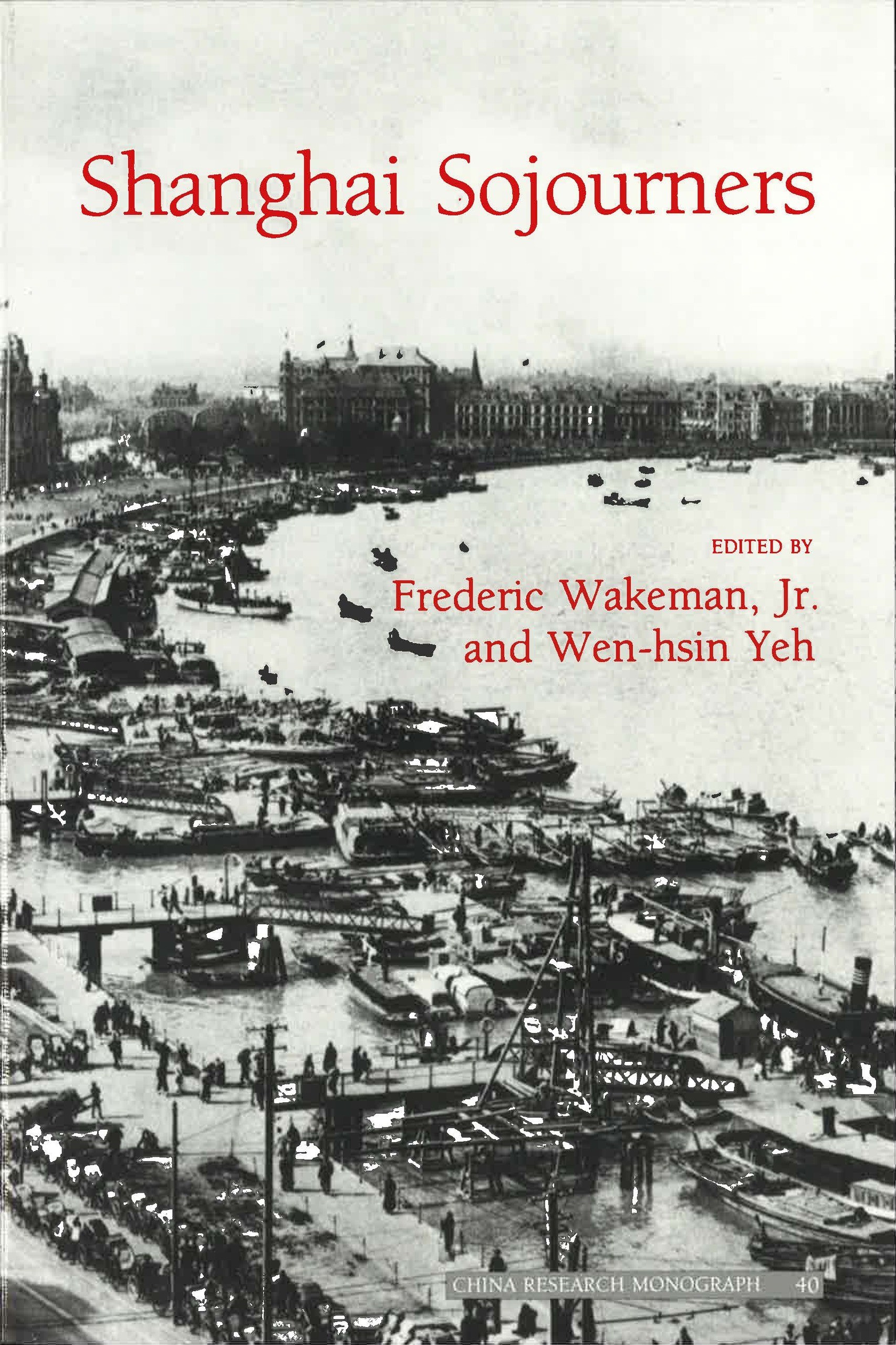
Shanghai Sojourners
- China Research Monograph
About the Author
Education: B.A. Harvard University, Ph.D. University of California, Berkeley
Education: B.A., History, National Taiwan University; M.A., History, University of Southern California; Ph.D., History, University of California, Berkeley
Table of Contents
Acknowledgments – vii
Contributors – ix
Map – xi
Introduction – 1
Frederic Wakeman, Jr., and Wen-hsin Yeh
1. The Shanghai Bankers' Association, 1915–1927: Modernization and the Institutionalization of Local Solidarities – 15
Marie-Claire Bergère
2. Three Roads into Shanghai's Market: Japanese, Western, and Chinese Companies in the Match Trade, 1895-1937 – 35
Sherman Cochran
3. New Culture, Old Habits: Native-Place Organization and the May Fourth Movement – 76
Bryna Goodman
4. The Evolution of the Shanghai Student Protest Repertoire; or, Where Do Correct Tactics Come From? – 108
Jeffrey Wasserstrom
5. Regulating Sex in Shanghai: The Reform of Prostitution in 1920 and 1951 – 145
Gail Hershatter
6. Progressive Journalism and Shanghai's Petty Urbanites: Zou Taofen and the Shenghuo Weekly, 1926–1945 – 186
Wen-hsin Yeh
7. Migrant Culture in Shanghai: In Search of a Subei Identity – 239
Emily Honig
8. ""The Pact with the Devil"": The Relationship between the Green Gang and the French Concession Authorities, 1925–1935 – 266
Brian G. Martin
9. Strikes among Shanghai Silk Weavers, 1927–1937: The Awakening of a Labor Aristocracy – 305
Elizabeth J. Perry
Index – 343
Reviews
"Shanghai Sojourners is an extraordinary anthology of articles on Shanghai society. The term 'sojourners' has been used to capture the nature of the metropolis’ residents from the granting of the foreign concessions to the early 1950s: transient, constantly changing, lacking roots, and wanting to start a new life....This outstanding volume deserves to be considered, not only as a historian’s, but anyone’s travel-guide to Shanghai, as it provides an excellent insight into the soul of the city."—Flemming Christiansen, University of Manchester, China Information
"This book is about the culture and society of a city of strangers, the Shanghai of the Republican era....It is primarily that of Chinese bankers, industrialists, workers, students, journalists, gangsters and prostitutes who only gradually came to think of themselves as 'Shanghai people.' Theirs was a Shanghai that, as the editors describe it, had an 'exotic, disturbing, polymorphous quality' that ended when a cosmopolitan Shanghai became 'securely Chinese' in 1949 (p. 14)."—William C. Kirby, The China Quarterly
"This symposium volume of nine articles, the product of a 1988 conference in Shanghai, has both an evocative and provocative title. Not only does the phrase 'Shanghai sojourners' help conjure up the exotic and complex image of the city from its opening to foreign trade in 1843 through the Communist takeover just over 100 years later, but it also raises a number of intriguing questions about what it meant to live in Shanghai and how that differed from living in other parts of China....Using a rich variety of research methods and many newly-opened archival sources in Shanghai, the authors focus on the period from the late nineteenth century to the 1940s, but with special emphasis on the 1920s and 30s."—Pamela Atwell, Journal of the Royal Asiatic Society
