University of California Press

About the Book

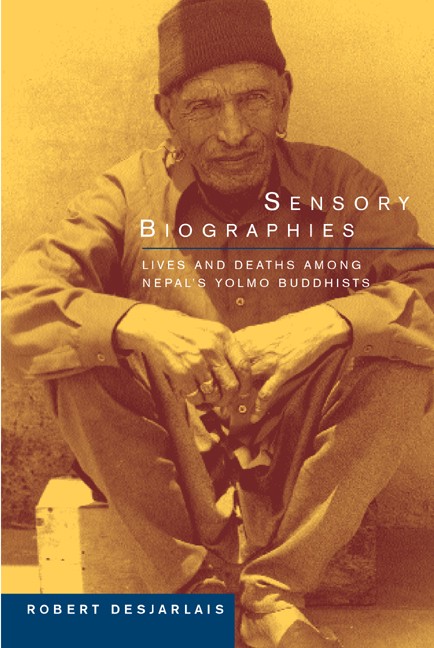
Robert Desjarlais's graceful ethnography explores the life histories of two Yolmo elders, focusing on how particular sensory orientations and modalities have contributed to the making and the telling of their lives. These two are a woman in her late eighties known as Kisang Omu and a Buddhist priest in his mid-eighties known as Ghang Lama, members of an ethnically Tibetan Buddhist people whose ancestors have lived for three centuries or so along the upper ridges of the Yolmo Valley in north central Nepal.

It was clear through their many conversations that both individuals perceived themselves as nearing death, and both were quite willing to share their thoughts about death and dying. The difference between the two was remarkable, however, in that Ghang Lama's life had been dominated by motifs of vision, whereas Kisang Omu's accounts of her life largely involved a "theatre of voices." Desjarlais offers a fresh and readable inquiry into how people's ways of sensing the world contribute to how they live and how they recollect their lives.

About the Author

Robert Desjarlais is Associate Professor of Anthropology at Sarah Lawrence College. His most recent book is Shelter Blues (1997), for which he won the Victor Turner Prize in Ethnographic Writing.

Table of Contents

List of Illustrations
Note on Transliteration

Kuragraphy
Hardship, Comfort
Twenty-Seven Ways of Looking at Vision
Startled into Alertness
A Theater of Voices
""I’ve Gotten Old""
Essays on Dying
""Dying Is This""
The Painful Between
Desperation
The Time of Dying
Death Envisioned
To Phungboche, by Force
Staying Still
Mirror of Deeds
Dispersals
""So: Ragged Woman""
Echoes of a Life
A Son’s Death
The End of the Body
Last Words

Notes
Glossary of Terms
References
Acknowledgments
Index

Reviews

"If you have ever looked deeply at someone across a lingustic, cultural, or self other divide and wondered what it would be like to know the world as that person does, this is a book that you will probably find fascinating. On one level, Robert Desjarlais's latest contribution to an emerging "anthropology of the senses" is a compelling presentation of the life histories of two Yolmo elders nearing the ends of their lives in Kathmandu. At another, it is an extended exploration of the ways that sensory engagements the physical modalities through which people perceive material worlds articulate both broad social dynamics and uniquely personal dispositions. The result is a phenomenologically tuned, person-centered account of the relations among culture, bodily practice, and human subjectivities."
Journal of Asian Studies
"An elegant ethnographic description of the life histories of Ghang Lama, a Buddhist priest, and Kisang Omu, a devoted female layperson. . . .One of Desjarlais's gifts is his ability to capture not just the content but the style and context of his discussant's words."
Journal of Religion
"One of the most powerful ethnographies in any field that I have read in recent years. A model of anthropological analysis that addresses questions on the cutting edge of the discipline."—Veena Das, author of Critical Events: An Anthropological Perspective on Contemporary India