University of California Press

About the Book

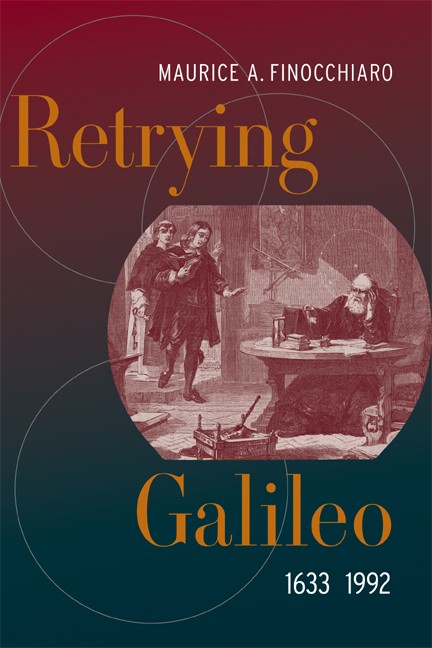
In 1633, at the end of one of the most famous trials in history, the Inquisition condemned Galileo for contending that the Earth moves and that the Bible is not a scientific authority. Galileo's condemnation set off a controversy that has acquired a fascinating life of its own and that continues to this day. This absorbing book is the first to examine the entire span of the Galileo affair from his condemnation to his alleged rehabilitation by the Pope in 1992. Filled with primary sources, many translated into English for the first time, Retrying Galileo will acquaint readers with the historical facts of the trial, its aftermath and repercussions, the rich variety of reflections on it throughout history, and the main issues it raises.

About the Author

Maurice A. Finocchiaro, Distinguished Professor of Philosophy Emeritus at the University of Nevada-Las Vegas, is author of Beyond Right and Left: Democratic Elitism in Mosca and Gramsci (1999) and Galileo on the World Systems: A New Abridged Translation and Guide (1997), among other books.

Table of Contents

Contents
Preface and Acknowledgments
Introduction. The Galileo Affair from Descartes to John Paul II: A Survey of Sources, Facts, and Issues

1. The Condemnation of Galileo (1633)
2. Promulgation and Diffusion of the News (1633-1651)
3. Emblematic Reactions: Descartes, Peiresc, Galileo's Daughter (1633-1642)
4. Polarizations: Secularism, Liberalism, Fundamentalism (1633-1661)
5. Compromises: Viviani, Auzout, Leibniz (1654-1704)
6. Myth-making or Enlightenment? Pascal, Voltaire, the Encyclopedia (1657-1777)
7. Incompetence or Enlightenment? Pope Benedict XIV (1740-1758)
8. New Lies, Documents, Myths, Apologies (1758-1797)
9. Napoleonic Wars and Trials (1810-1821)
10. The Inquisition on Galileo's Side? The Settele Affair (1820) and Beyond (1835)
11. Varieties of Torture: Demythologizing Galileo's Trial? (1835-1867)
12. A Miscarriage of Justice? The Documentation of Impropriety (1867-1879)
13. Galileo Right Again, Wrong Again: Hermeneutics, Epistemology, ""Heresy"" (1866-1928)
14. A Catholic Hero: Tricentennial Rehabilitation (1941-1947)
15. Secular Indictments: Brecht's Atomic Bomb and Koestler's Two Cultures (1947-1959)
16. History on Trial: The Paschini Affair (1941-1979)
17. More ""Rehabilitation"": Pope John Paul II (1979-1992)

Epilogue: Unfinished Business
Notes
Select Bibliography
Index
Reviews

“Finocchiaro has not only done a great service to historical scholarship, he has also brought a very important chapter of cultural history within reach of the average educated reader. A very relevant book in this age of science-religion dialogues....Highly recommended.”
Choice: Current Reviews For Academic Libraries
“He has done Galileo scholars everywhere a service with this exhaustive book, which examines an enormous number of primary sources and quotes them at length, many in English translation for the first time. . . .Overall, this book is a major contribution. It is comprehensive and insightful and thus likely to be seen as a definitive work on the subject.”
Bridges: A Lib-Con Dialogue
“If you have ever wondered about Galileo and the myths that surround him, most of your questions will be answered in Maurice Finocchiaro’s Retrying Galileo. . . . These questions and many more are answered in the informative tales and fascinating stories that Finocchiaro recounts.”
Science
“The book is an invaluable resource and a landmark–a uniquely comprehensive survey of the twists and turns of the Galileo story. Finocchiaro’s rich historical narrative illuminates such perennial questions as the conflict between science and religion and the conflict between individual freedom and institutional authority.”
American Scientist
"This is must reading for historians of science and a delight for the interested public. From his access to many primary sources in the Vatican Library and from his broad knowledge of the history of the 17th century, Finocchiaro acquaints readers in an interesting manner with the historical facts of Galileo's trial, its aftermath, and its repercussions. Unlike many other works which present predetermined and, at times, prejudiced judgments, this work provides exhaustive evidence to allow readers to develop their own informed opinion on the subject.”—George V. Coyne, Director, Vatican Astronomical Observatory

“The tragic condemnation of Galileo by the Roman Catholic Church in 1633 has become the single most potent symbol of authoritarian opposition to new ideas. Pioneering in its scope, Finocchiaro's book provides a fascinating account of how the trial and its cultural significance have been freshly reconstructed by scholars and polemicists down the ages. With a philosopher's eye for fine distinctions, the author has written an exciting commentary on the successive appearance of new primary sources and their exploitation for apologetic and secular purposes.”—John Hedley Brooke, author of Science and Religion: Some Historical Perspectives

"If good history begins with good facts, then Retrying Galileo should be the starting point for all future discussions of the post-trial phase of the Galileo affair. Maurice Finocchiaro's myth-busting documentary history is not only a repository of little-known sources but a pleasure to read as well.”—Ronald L. Numbers, co-editor of When Christianity and Science Meet

Retrying Galileo tells the less well-known half of the Galileo affair: its long and complex history after 1633. Finocchiaro has performed an invaluable service in writing a book that explores how the trial and condemnation of Galileo has been received, debated, and reinterpreted for over three and a half centuries. We are not yet done with this contentious story.”—Paula E. Findlen, Ubaldo Pierotti Professor of Italian History and Director of the Science, Technology and Society Program, Stanford University