University of California Press

About the Book

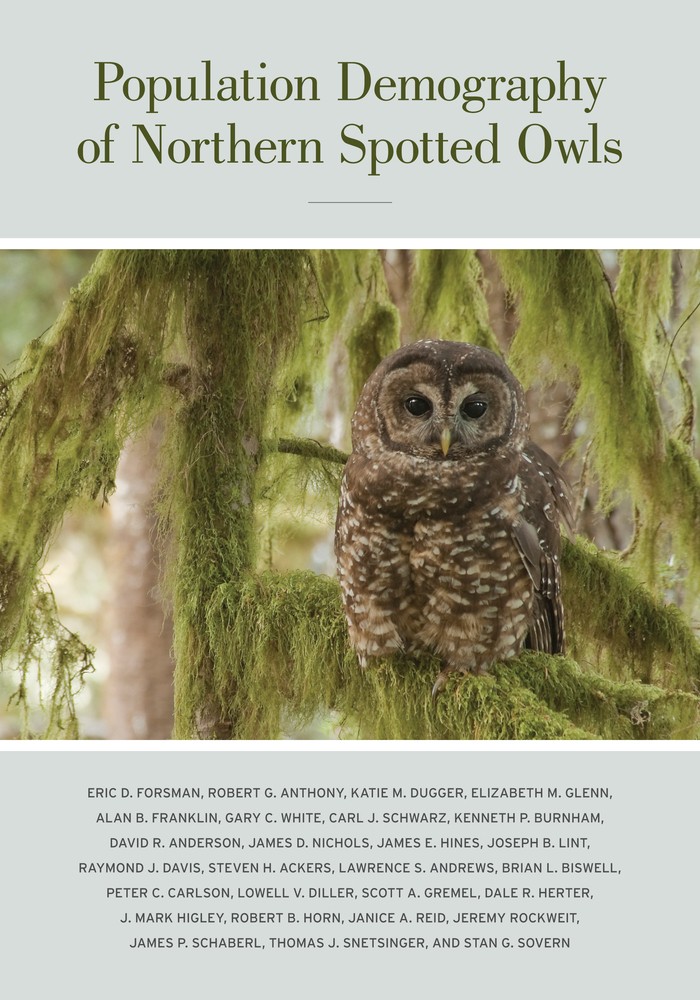
The Northern Spotted Owl, a threatened species that occurs in coniferous forests in the western United States, has become a well-known environmental symbol. But how is the owl actually faring? This book contains the results of a long-term effort by a large group of leading researchers to document population trends of the Northern Spotted Owl. The study was conducted on 11 areas in the Pacific Northwest from 1985 to 2008, and its objectives were both to evaluate population trends and to assess relationships between reproductive rates and recruitment of owls and covariates such as weather, habitat, and the invasion of a closely related species, the Barred Owl. Among other findings, the study shows that fecundity was declining in five populations, stable in three, and increasing in three areas. Annual apparent survival rates of adults were declining in 10 out of 11 areas. This broad, synthetic work provides the most complete and up-to-date picture of the population status of this inconspicuous forest owl, which is at the center of the complex and often volatile debate regarding the management of forest lands in the western United States.

Researchers:
Steven H. Ackers
Lawrence S. Andrews
David R. Anderson
Robert G. Anthony
Brian L. Biswell
Kenneth P. Burnham
Peter C. Carlson
Raymond J. Davis
Lowell V. Diller
Katie M. Dugger
Eric D. Forsman
Alan B. Franklin
Elizabeth M. Glenn
Scott A. Gremel
Dale R. Herter
J. Mark Higley
James E. Hines
Robert B. Horn
Joseph B. Lint
James D. Nichols
Janice A. Reid
James P. Schaberl
Carl J. Schwarz
Thomas J. Snetsinger
Stan G. Sovern
Gary C. White

About the Author

Eric D. Forsman, who collaborated with a team of twenty-seven researchers to produce this report, is a Wildlife Biologist with the USDA Forest Service’s Pacific Northwest Research Station, and also holds a courtesy faculty position as an Associate Professor in the Department of Fisheries and Wildlife at Oregon State University.

Table of Contents

INTRODUCTION

STUDY AREAS

FIELD METHODS

ANALYTICAL METHODS
DEVELOPMENT OF COVARIATES
Barred Owl covariate
Habitat covariates
Weather and climate covariates
Land ownership, ecoregion, and latitude covariates
Reproduction covariate

FECUNDITY
Individual study areas
Meta-analysis of fecundity

APPARENT SURVIVAL
Individual study areas
Meta-analysis of apparent survival

ANNUAL RATE OF POPULATION CHANGE
Individual study areas
Estimates of realized population change
Meta-analysis of annual rate of population change

STATISTICAL CONVENTIONS

WORKSHOP PROTOCOLS

RESULTS
FECUNDITY
Individual study areas
Meta-analysis of fecundity

APPARENT SURVIVAL
Individual study areas
Meta-analysis of apparent survival on all areas
Meta-analysis of apparent survival on the eight NWFP monitoring areas
Potential cost of reproduction on survival
Effects of Barred Owls on recapture and survival

ANNUAL RATE OF POPULATION CHANGE
Individual study areas
Estimates of realized population change
Meta-analysis of annual rate of population change

DISCUSSION
FECUNDITY

APPARENT SURVIVAL

ANNUAL RATE OF POPULATION CHANGE AND REALIZED RATES OF POPULATION

CHANGE
Individual study areas
Meta-analysis of annual rate of population change

STATUS OF OWL POPULATIONS IN THE EIGHT NWFP MONITORING AREAS

ASSOCIATIONS BETWEEN DEMOGRAPHIC PARAMETERS AND COVARIATES
Cost of reproduction on survival
Weather and climate
Barred Owls
Habitat

POTENTIAL BIASES IN ESTIMATES OF DEMOGRAPHIC PARAMETERS
Fecundity
Apparent survival
Annual rate of population change
Estimating goodness-of-fit and overdispersion

SUMMARY, CONCLUSIONS, and RECOMMENDATIONS

ACKNOWLEDGMENTS

LITERATURE CITED

APPENDICES

TABLES

FIGURES

Reviews

"The book is one of the most exact and large-scale metapopulation analyses in the world, based on work of 27 experts . . . It is a good example to show that the ultimate reasons for population changes can not be fully understood without extensive meta-analyses."
Luonnon Tutkija
"In addition to state of the art analysis of huge datasets, this monograph provides a wonderful example of cooperation among scientists and field biologists to achieve a common goal. The monograph provides an analysis template for any species whose conservation is controversial or its population analysis challenging. Therefore, it is a must-read for all population ecologists, wildlife biologists and managers, conservation biologists, and graduate students in these fields.”—R.J. Gutiérrez, University of Minnesota

“This state-of-the-art examination of the demography of the Northern Spotted Owl serves as a model of the information needed for truly scientific conservation of at-risk species. If only we could gather similar information for all plants and animals facing uncertain futures.”—John Faaborg, University of Missouri at Columbia

"This book on demography of spotted owl populations is an excellent and comprehensive contribution to the literature on ecology and conservation of owls. It warrants to be read by all biologists and naturalists interested in fascinating raptors and owls"--Erkki Korpimäki, University of Turku, Finland


Awards

  • TWS Wildlife Publication Award 2012, Wildlife Society