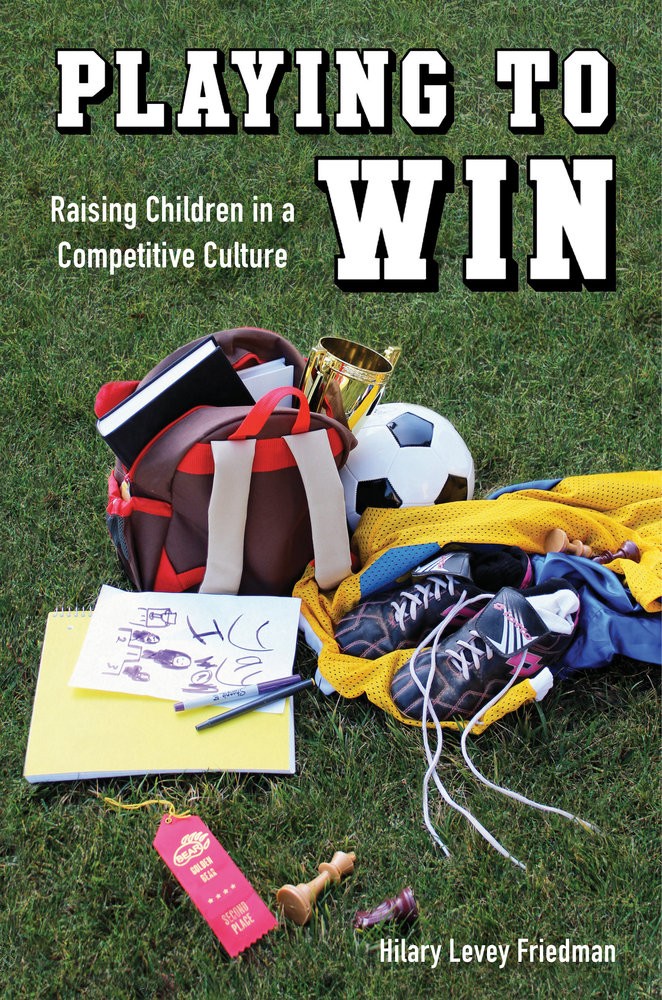
"Top 12 Must-Read Education Books . . . . Harvard sociologist Friedman follows children involved in chess, dance and soccer, showing the differences among these sub-groups, how and why these competitive activities work and the resulting implications for inequality and gender in the educational system."
"This book is a must-read for scholars interested in family, childhood, and stratification. It would also be a thought-provoking text for undergraduate students, many of whom may have participated in competitive activities throughout their lives."
"Richly textured... insightful."
"Beautifully written, relentlessly insightful, and methodologically innovative, Playing to Win expertly captures the perspectives of parents and children regarding the importance of after school activities for socialization and childhood in contemporary American society. Hilary Levey Freidman has produced a sociological gem."--William A. Corsaro, author of The Sociology of Childhood
"Hilary Levey Friedman has written an instant classic about parents, children, and the fervent pursuit of competitive honor in American society. Richly descriptive, terrifyingly honest, and beautifully written, Playing to Win is a must read for anyone who cares about the happiness and fulfillment of our children, the values we celebrate as a country, and the very foundations of our social world."—Francesco Duina, author of Winning: Reflections on an American Obsession
“Hilary Levey Friedman’s Playing to Win is an essential social science volume that transcends the boundary between scholarship and popular critique. Levey Friedman successfully explains how upper-middle class Americans think about their children’s engagement in serious leisure: competitive chess, dance competitions, and youth soccer. Listening carefully to both parents and children, she reveals the tensions and contradictions, benefits and drawbacks of intense competitions, and provides a perspective necessary for researchers who examine child development and for parents who wish to raise happy, healthy children.”—Gary Alan Fine, author of With the Boys and Gifted Tongues: High School Debate and Adolescent Culture
"The world of 21st century childhood has found its superb interpreter. With sparkling arguments and fascinating evidence, Hilary Levey Friedman’s Playing To Win introduces us to one of America’s most remarkable contemporary innovations: the proliferation of organized, competitive after-school activities. An important contribution to the sociology of culture and inequality."—Viviana A. Zelizer, author of Pricing the Priceless Child
"Hilary Levey Friedman has written a book of Tocquevillian dimension. Her insights into the worries and hopes of the many gendered facets and class-bound manifestations of America's contemporary middle class are not only brilliant but presented in a lucid style that makes this book a real page turner. "Competitive Kid Capital" will rightly enter the vernacular of contemporary sociology."—Andrei S. Markovits, co-author of SPORTISTA: Female Fandom in the United States
"Hilary Levey Friedman has managed to convince numerous upper middle class parents and their children to pause from their mad dash between extra-curricular activities to explain why they have chosen this lifestyle. Using information from detailed interviews across a variety of activities, she provides a revealing account of the motivations that lie behind the dramatic rise in competitive children's activities. This fascinating book forms a key part of an emerging body of research that links the increase in time devoted to childcare to parents' worries about their children's economic futures."—Valerie Ramey, Professor and Chair of Economics, University of California, San Diego
"It is a valuable study and an excellent, highly readable report. I recommend the book to anyone who wishes to understand the mental set of many modern parents, which leads them to turn what should be playtime into work time for their kids."—Peter Gray, American Journal of Play