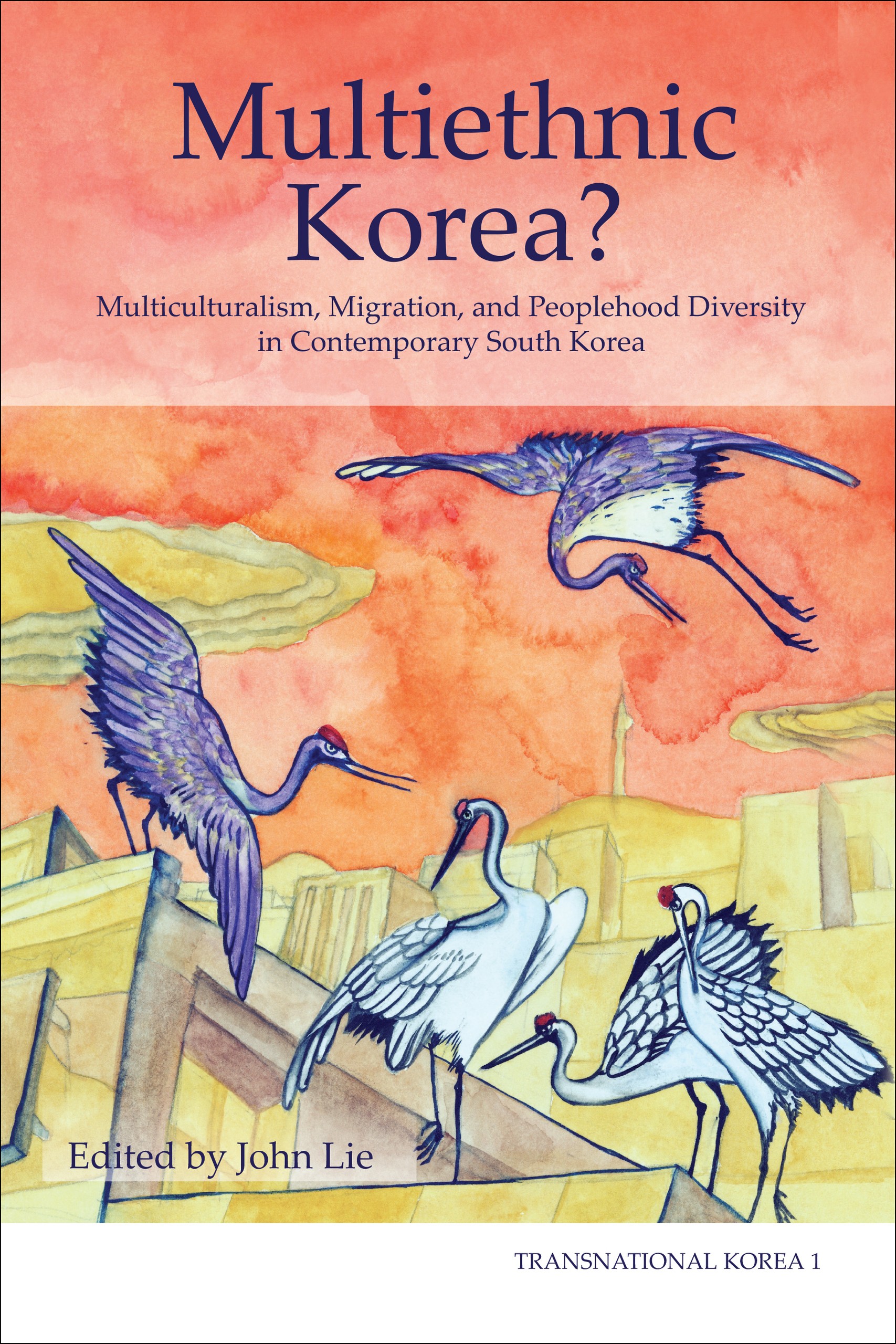
Multiethnic Korea?
- Transnational Korea
About the Author
Table of Contents
Preface – vii
Contributors – ix
1. Introduction: Multiethnic Korea —1
John Lie
Part I: An Emergent Multiethnic Multicultural Society?
2. Late Migration, Discourse, and the Politics of Multiculturalism in South Korea: A Comparative Perspective —31
Timothy C. Lim
3. Korea: Multiethnic or Multicultural? —58
Nora Hui-Jung Kim
4. Tolerance, Tamunhwa , and the Creating of the New Citizens —79
EuyRyung Jun
5. Makeshift Multiculturalism: The Transformation of Elementary School Teacher Training —95
Nancy Abelmann, Gayoung Chung, Sejung Ham, Jiyeon Kang, and Q-Ho Lee
Part II: Migrants and Others
6. The Needs of Others: Revisiting the Nation in North Korean and Filipino Migrant Churches in South Korea—119
Hae Yeon Choo
7. North Korean Migrants in South Korea: From Heroes to Burdens and First Unifiers —142
Jin-Heon Jung
8. Beyond Motherlands and Mother Love: Locating Korean Adoptees in Global Korea —165
Eleana Kim
9. Diverging Paths, Converging Ends: Japan’s and Korea’s Low-Skilled Immigration Policies, 1990–2010 —184
Keiko Yamanaka
Part III: Diversifying Korea
10. Race-ing toward the Real South Korea: The Cases of Black-Korean Nationals and African Migrants —211
Nadia Y. Kim
11. Almost Korean: Korean Amerasians in an Era of Multiculturalism —244
Sue-Je L. Gage
12. Can the Union of Patriarchy and Multiculturalism Work? Family Dynamics in Filipina-Korean Rural Households —277
Minjeong Kim
Part IV: Coda
13. Korean Multiculturalism in Comparative Perspective —301
Jack Jin Gary Lee and John D. Skrentny
Index —331
Reviews
"As a comprehensive and important collection of research on Korean peoplehood, this edited volume pushes us to think about and recognize co-ethnic Korean migrants, migrants who form families in South Korea, and people with partly Korean ethnicities. It is intended to be useful for advanced undergraduate and graduate courses on Korea, international migration, ethnicity, and East Asia. The book will also provide insights not only for Koreanists and Asianists, but also for scholars in the fields of migrants, globalization, sociology, comparative politics, and policy." —Claire Seungeun Lee, University of Massachusetts, Boston, Asian Ethnology 75, no. 2 (2016): 498–501
"Although much has been written in Korean on multiculturalism in Korea over the past decade or so, there is a lack of similar scholarship in English. "Multiethnic Korea?" makes a good start at addressing this lack, identifying the challenges that Korea faces on both the policy and personal levels as the nation moves into an increasingly diverse future. The conversation on multiculturalism cannot be dominated by any one voice, and it is hoped that this volume will inspire and encourage open dialogue between all those involved."—Charles La Shure and Lee Woo-young, Koreana (Winter 2015): 74.
"Multiethnic Korea? is essential reading for scholars interested in the broad field of Korean Studies and, indeed, thanks to its accessible, jargon-free language, any critical reader who is interested in unpacking the contemporary 'multicultural' landscape of Korea. Although most of the chapters are oriented toward the social sciences, their applicability may be extended to the humanities, particularly as multicultural residents are becoming a visible presence in the Korean media. Each chapter is insightful as a stand-alone piece, but their significance grows when considered in relation to each other, especially as the contributors tend to cite each other, engaging in productive dialogues."—Eun-hae Kim, Yonsei University, Situations 10.1 (2017): 153–158
"The book rightly revels in the contradictions and inconsistencies in a lot of the current beliefs in, and policies of, multiculturalism. It is with this kind of well-researched and critical literature that barriers to a genuine multiethnicity and multiculturalism in Korea might be lifted."—Iain Watson, Ajou University, Suwon, South Korea, Pacific Affairs 90, no. 2 (July 2017): 374–376.
