University of California Press
Publishing Services

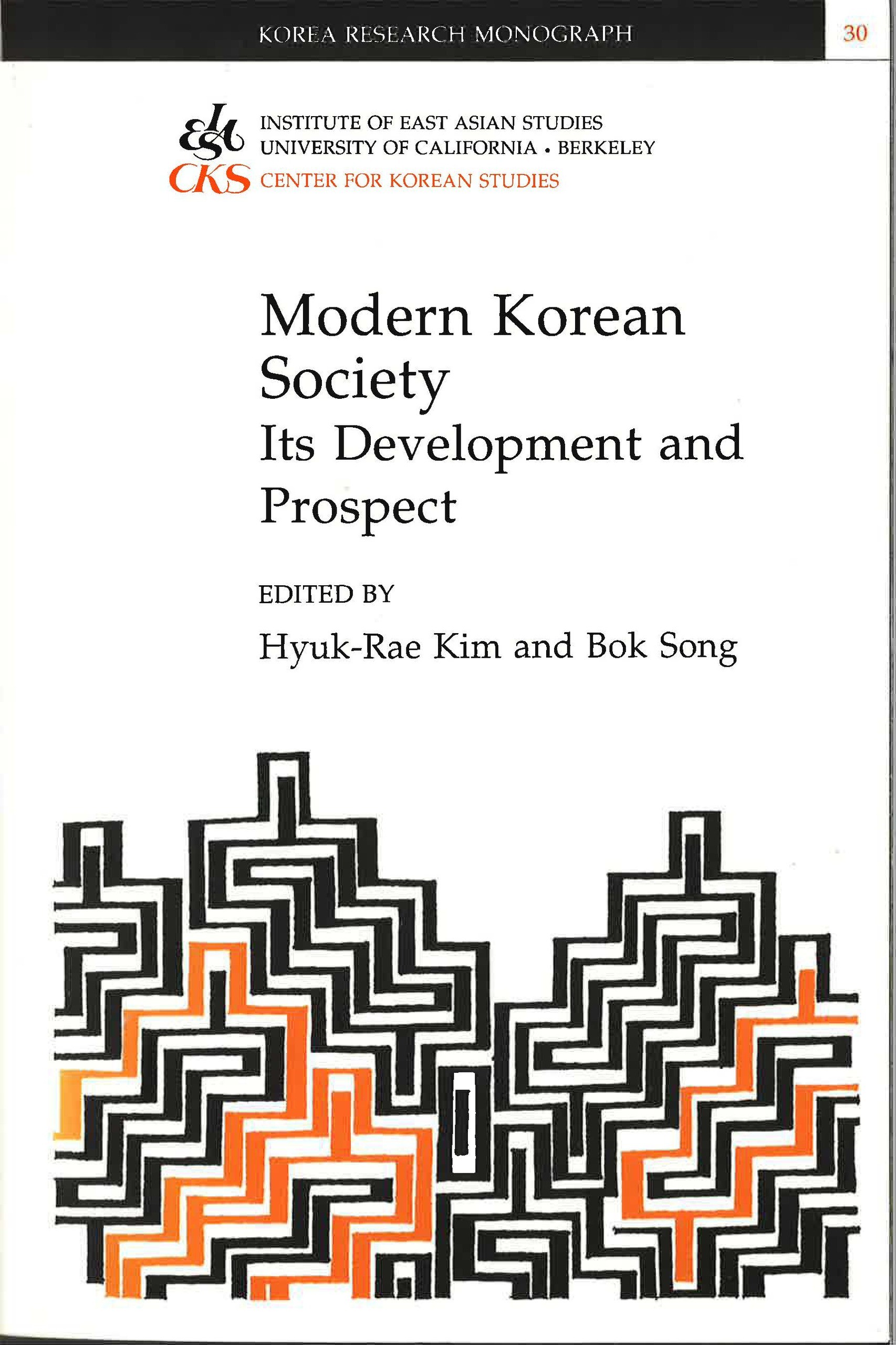
Modern Korean Society

Its Development and Prospect

by Hyuk-Rae Kim (Editor), Bok Song (Editor)
Price: $25.00 / £21.00
Publication Date: Jan 2007
Publisher:
Institute of East Asian Studies, University of California, Berkeley
Imprint: Institute of East Asian Studies, University of California, Berkeley
Title Details:
Rights: World
Pages: 268
ISBN: 9781557290861
Trim Size: 6 x 9
Series:
  • Korea Research Monograph

About the Book

This volume is a comprehensive survey textbook on modern Korean society. The contributors discuss key issues of modern Korean studies, including regionalism, inequality, and division. The common theme is the influence of Korea's unique traditional elements on the modernization process and the country's prospects for the future.

About the Author

Hyuk-Rae Kim is chair of the Korean studies program and professor of Korean studies at Yonsei University. Education: Ph.D. University of Washington

Bok Song is professor emeritus of sociology at Yonsei University.

Table of Contents

Acknowledgements – vii

1. The Contour of Modern Korean Society – 1
    Hyuk-Rae Kim

2. Regionalism and National Networks – 16
    Yong-Hak Kim

3. The Korean Stratification System: Continuity and Change – 36
    Hagen Koo

4. Inequality and Class Reproduction in Everyday Life – 63
    Wang-Bae Kim and Bok Song

5. Economic Governance: Its Historical Development and Future Prospects – 79
    Hyuk-Rae Kim

6. From Take-off to Drop-off?: Postwar Economic Development and Industrialization – 106
    Karl J. Fields

7. Family, Gender, and Sexual Inequality – 131
    Seung-Kyung Kim

8. Population Changes and Urbanization – 158
    Kye-Choon Ahn

9. Social Grievances and Social Protests against the Oppressive State – 179
    Dong-No Kim

10. The Making of Civil Society in Historical Perspective – 205
    Hyuk-Rae Kim

11. Division, War, and Reunification – 226
    Bruce Cumings

Index – 249

Contributors – 255
Reviews

"This books strengths are many, but let me focus on three. First, the analysis contained in the chapters strikes an appropriate balance between detailing the unique aspects of ROK society and placing the ROK in comparative context with the West….Second, the book deals with a wide range of topics under the broad umbrella of "modern society"....Third, many chapters in this book introduce Korean terminology to more accurately describe contemporary ROK society."—Eun Mee Kim, Ewha Woman's University, The Journal of Asian Studies 68, no. 3 (August 2009): 1003–1005.

"[This book] is foremost an excellent compilation of chapters that discuss the key issues of Korea's political, economic, and social development....Another definite merit of this book is that the contributing authors are must-read scholars who have established expertise in each area of Korean studies. With this edited volume, teachers and students who are engaged in understanding the complexities of modern Korea will benefit from the authors' comprehensive and theoretical exposition of diverse issues that have arisen along the contours of Korea's development."—Yoonkyung Lee, State University of New York–Binghamton, Korean Studies 32 (2008): 203–205.

"Editors Kim and Song set out to 'introduce and explicate Korea's modernization process, from its development thus far to its future prospects'(vii). Theirs is indeed a handy single volume on the sociological contexts and contours of South Korean society. There is no question that Modern Korean Society is informed by the 1997 so-called IMF Crisis, which demanded both considerable economic restructuring (liberalization) as well as intellectual introspection as to the longstanding character of South Korean capitalism, and social organization more broadly. It is from this vantage point that many of the chapters interrogate particular South Korean features, setting them in their particular historical contexts, and in the idiom of co-editor Hyuk-Rae Kim, considering their 'viability.'" —Nancy Abelmann, University of Illinois, Urbana, Pacific Affairs 80, no. 2 (Summer 2007): 386–387.