University of California Press

About the Book

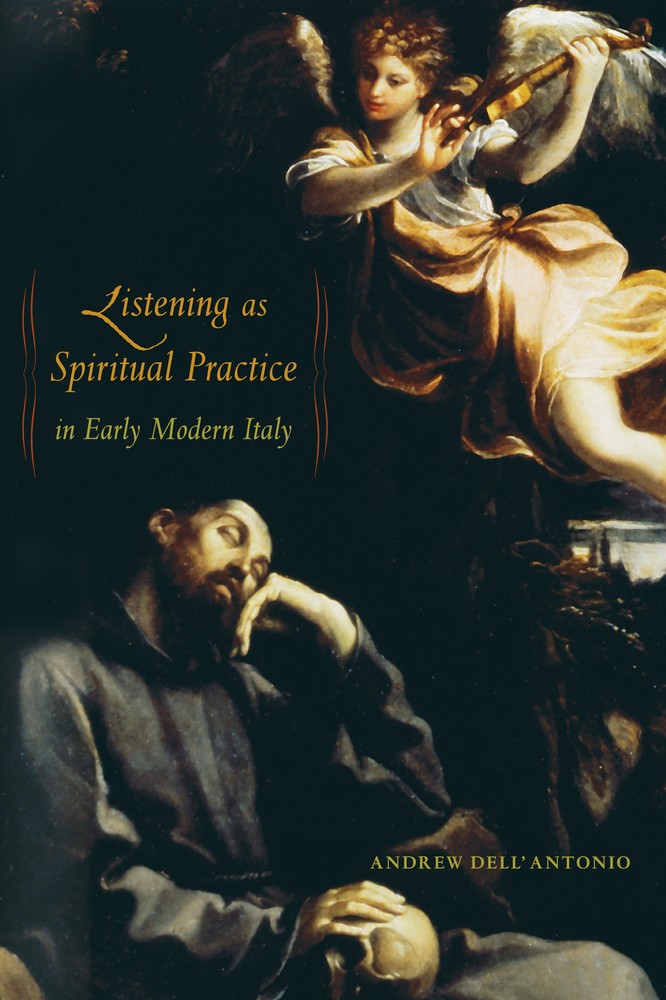
The early seventeenth century, when the first operas were written and technical advances with far-reaching consequences—such as tonal music—began to develop, is also notable for another shift: the displacement of aristocratic music-makers by a new professional class of performers. In this book, Andrew Dell’Antonio looks at a related phenomenon: the rise of a cultivated audience whose skill involved listening rather than playing or singing. Drawing from contemporaneous discourses and other commentaries on music, the visual arts, and Church doctrine, Dell’Antonio links the new ideas about cultivated listening with other intellectual trends of the period: humanistic learning, contemplative listening (or watching) as an active spiritual practice, and musical mysticism as an ideal promoted by the Church as part of the Catholic Reformation.

About the Author

Andrew Dell’Antonio is Professor in the Musicology/Ethnomusicology Division at the University of Texas at Austin, Butler School of Music. He is a former Mellon Fellow at the Harvard-Villa I Tatti Center for Italian Renaissance Studies and the editor of Beyond Structural Listening? Postmodern Modes of Hearing (UC Press).

Table of Contents

Acknowledgments

Introduction: Listening as Spiritual Practice
1. Rapt Attention
2. Aural Collecting
3. Proper Listening
4. Noble and Manly Understanding
Envoy: From Gusto to Goût

Appendix: Lelio Guidiccioni, “Della Musica”: Transcription and Translation
Notes
Bibliography
Index

Reviews

"Listening as Spiritual Practice aligns in new ways many of our understandings of early modern musical culture."
Renaissance Quarterly
“How might virtuosity make one virtuous? In this new brilliant new study, Dell’Antonio takes the reader into the heart of elite masculine circles in post-Tridentine Rome, where listening to the ‘new music’ was an active process, and music, like the art objects collected by noble patrons, provided a path to spiritual enlightenment. A major contribution that enhances our understanding of seventeenth-century music and its relationship to theology, rhetoric, and the visual arts.”

—Wendy Heller, author of Emblems of Eloquence: Opera and Women’s Voices in Seventeenth-Century Venice


“This highly intelligent, deeply researched, and fascinating book is an important contribution to the cultural history of early seventeenth-century Italy, and especially to new interdisciplinary approaches to the historiography of musical aesthetics. Its exploration of the construction of late Renaissance and early Baroque cultural and spiritual mentalities through the medium of listening breaks new ground and provides a wealth of fresh perspectives that help to elucidate early modern understanding of the links between senses and sensibilities.”

—Richard Wistreich, Dean of Research and Enterprise, Royal Northern College of Music