University of California Press
Publishing Services

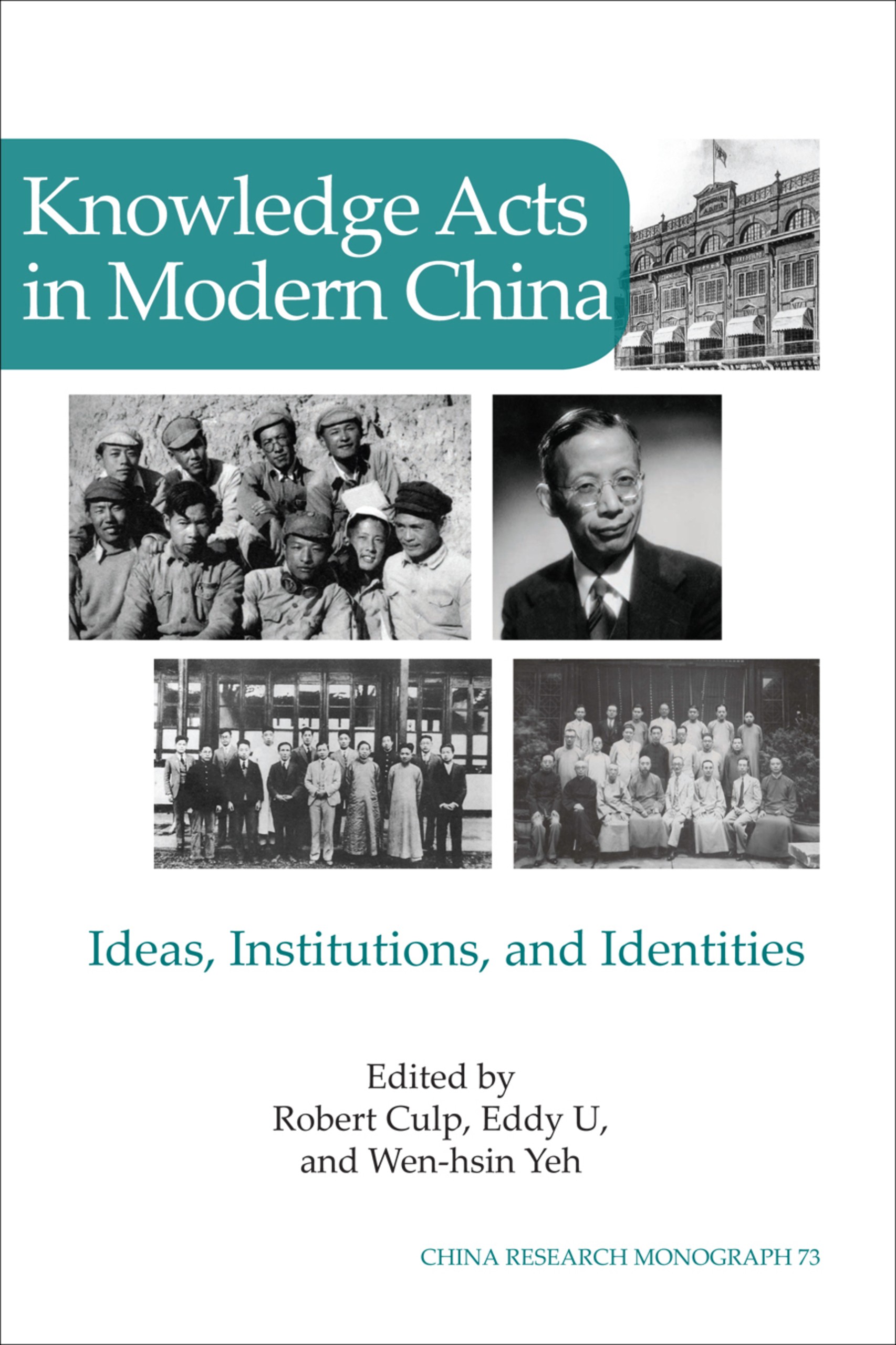
Knowledge Acts in Modern China

Ideas, Institutions, and Identities

by Robert Culp (Editor), Wen-hsin Yeh (Editor), Eddy U (Editor)
Price: $32.00 / £27.00
Publication Date: Jan 2016
Publisher:
Institute of East Asian Studies, University of California Berkeley
Imprint: Institute of East Asian Studies, University of California Berkeley
Title Details:
Rights: World
Pages: 396
ISBN: 9781557291738
Trim Size: 6 x 9
Series:
  • China Research Monograph

About the Book

This volume explores the introduction of new systems of knowledge in China during the first half of the twentieth century. The individuals portrayed here illustrate how modern systems of thought gave life to social institutions and generated new social roles and identities in China’s tumultuous transition during the first half of the twentieth century. In particular, we track the formation of academic and professional disciplines that have represented scientific rationality, technical regulation, impersonality, and intellectual enlightenment, all thought to be constitutive, as well as indicative, of modernity. With such a focus, this book joins an ongoing discussion about Chinese experiences of modernity as a social and material process, in addition to encompassing a mindset and new systems of ideas. This book extends this inquiry to consider how the interplay among ideas, institutions, and identities has characterized and shaped Chinese modernity.

About the Author

Robert J. Culp is associate professor of history and chair of the Social Studies Division at Bard College.

Eddy U is associate professor of sociology at the University of California, Davis. His research interests include political sociology, historical sociology, the sociology of intellectuals, and Chinese society and politics. He is the author of Disorganizing China: Counter-bureaucracy and the Decline of Socialism (Stanford University Press, 2007) and co-editor of Knowledge Acts in Modern China: Ideas, Institutions, and Identities (Institute of East Asian Studies, UC Berkeley, 2016). Education: Ph.D. at University of California, Berkeley

Wen-hsin Yeh is professor of history at the University of California, Berkeley. She has served as the director of the Institute of East Asian Studies and the chair of the Center for Chinese Studies at Berkeley. She has edited and contributed to many IEAS publications, including Mobile Subjects; Mobile Horizons; History in Images; Cities in Motion; Empire, Nation, and Beyond; Cross-Cultural Readings of Chineseness; Landscape, Culture, and Space in Chinese Society; and Shanghai Sojourners. Education: B.A., History, National Taiwan University; M.A., History, University of Southern California; Ph.D., History, University of California, Berkeley

Table of Contents

Introduction: Knowledge Systems, Knowledge Producers, and China’s Distinctive Modernity – Robert Culp and Eddy U

Part I. New Systems of Academic Learning
1. Coming to Terms with Global Competition: The Rise of Historical Geography in Early Twentieth-Century China– Tze-ki Hon
2. Drawing Boundaries in Sand: Anthropology in Republican China – Clayton Brown

Part II. Technical Knowledge and the Professions
3. From Literati to Legal Professionals: The First-Generation Chinese Law School Graduates and Their Career Patterns – Huei-min Sun
4. The Chinese Judge: From Literatus to Cadre, 1906-1949 – Glenn Tiffert
5. The Making of the Civil Engineer in China: Knowledge Transfer, Institution Building, and the Rise of a Profession – Elisabeth Köll

Part III. Media and the Market
6. Economics with Chinese Characteristics: The Production of Economic Knowledge in Early Republican China – Bryna Goodman
7. Mass Production of Knowledge and the Industrialization of Mental Labor: The Rise of the Petty Intellectual – Robert Culp
8. Journalism as a Field of Knowledge in Republican China: Ideas, Institutions, and Politics– Timothy B. Weston

Part IV. Party Control and Construction
9. Looking Toward the Future: State Standardization and Professionalization of Science in Wartime China – J. Megan Greene
10. Making Maoism: Ideology and Organizations in the Yan’an Rectification Movement, 1942-1944 – Timothy Cheek
11. The Formation of Intellectuals in Yan’an – Eddy U

Reviews

“The volume rightly demonstrates how the evolution from literati to professional to mobilized intellectual was by no means inevitable. Rather, this evolution was a complex process, with state institutions, commercial markets, imperialists, and the war all contributing to myriad cultural, institutional and political conditions that informed how knowledge producers authenticated their status and defined their agendas. [...] The empirical case studies are fascinating unto themselves, but the overall volume makes an important contribution to the field by helping us better understand how, during a pivotal era in Chinese history, knowledge was produced, by whom, and for what purposes.”—Eugenia Lean, Columbia University, Frontiers of Literary Studies in China, 2018, 12(4): 715-719.