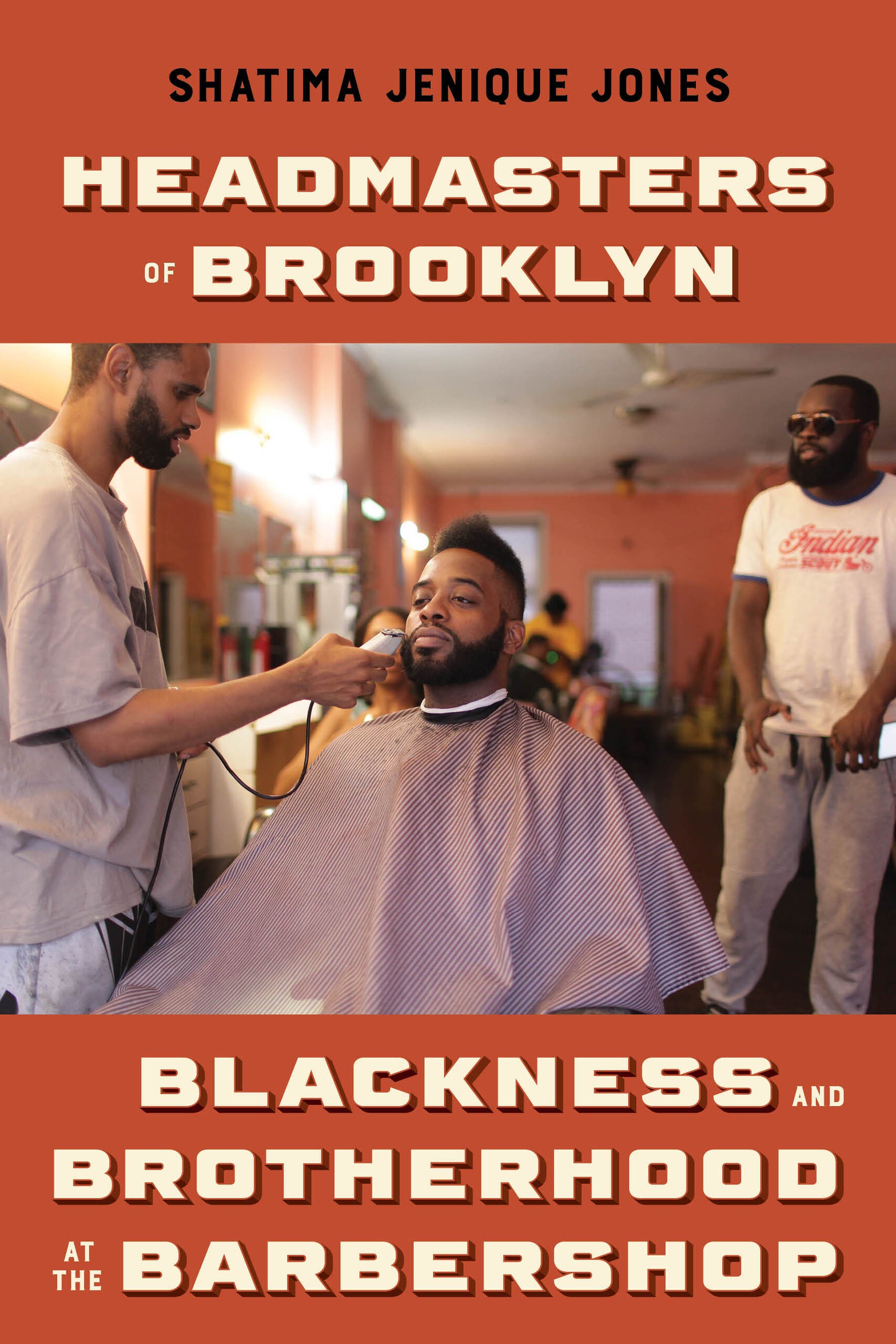
“The Black barbershop has been a fixture of film and politics for decades, but it has rarely gotten the sustained ethnographic attention Liebow gave Tally’s Corner or Anderson gave Jelly’s Place. Shatima Jones’s Headmasters of Brooklyn belongs on the shelf beside them. Over ten years at Headmasters—a Crown Heights barbershop with an N-word swear box, a chessboard, a mini-library, and a cast of characters fit for a novel—she shows how Black men build a moral universe out of haircuts and conversation: mentoring ‘young heads,’ caring for one another, policing authenticity, and, yes, disparaging women and their displaced neighbors in ways Jones refuses to excuse. Her account of being a Black woman—the ‘banana pudding lady’—in a man’s shop is some of the best reflexive-methods writing I know. And her ideas of the ‘racial front stage’ and ‘Black moral space’ brilliantly extend Du Bois’s double consciousness to the scrutiny Black men face from one another.”—Mitchell Duneier, Princeton University, author of Slim’s Table and Sidewalk
“While the Black barbershop is widely known as a key social institution within the Black community, Jones advances the conversation by interweaving analyses of race and gender with insightful reflections on culture, the dynamics of racial backstage and front stage, double consciousness, and gentrification. This is an excellent work of scholarship.”—Brandon A. Jackson, author of Brotherhood University: Black Men's Friendships and the Transition to Adulthood
“Shatima Jones offers a compelling demonstration of how studying local institutions can teach us about broad cultural and structural issues. At the end of the day, I’m not sure whether what most impresses me about Headmasters of Brooklyn is its deep anthropological insights or how much it resonates with me as a native Brooklynite who finds the voices in its pages familiar and authentic. And that is the hallmark of powerful ethnographic work: advancing social scientific scholarship while capturing the profoundly humanist ethos behind all great storytelling.”—John L. Jackson Jr., author of Thin Description: Ethnography and the African Hebrew Israelites of Jerusalem
“Headmasters of Brooklyn is a tremendous and cutting-edge book. Jones's writing is as rigorous as it is readable. With exceptional attention to the personalities of everyone she portrays, her work uniquely formulates the Black barbershop as both a moral space and a set of racial stages where the work of Black community construction takes shape.”—Quincy T. Mills, author of Cutting Along the Color Line: Black Barbers and Barber Shops in America