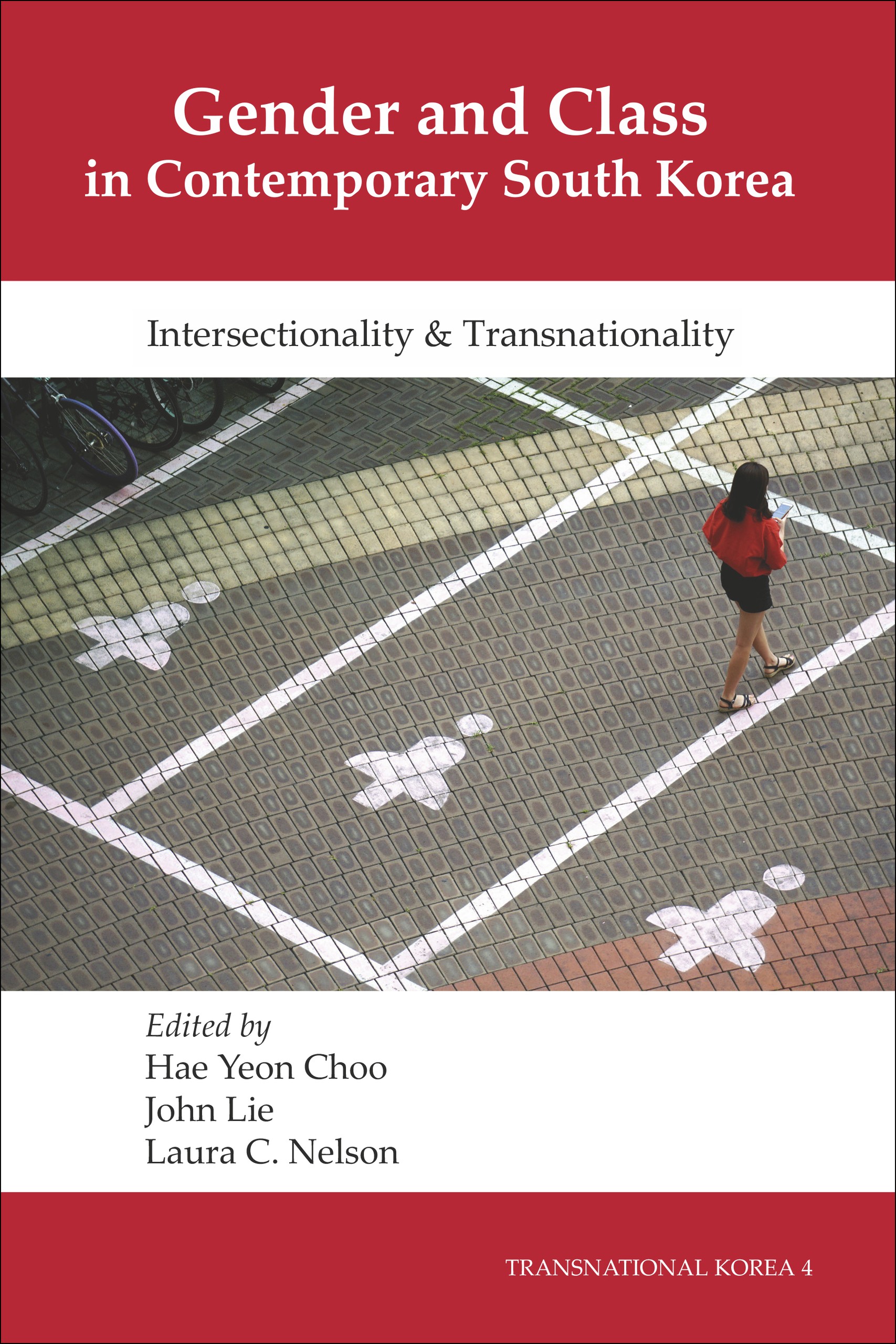
Gender and Class in Contemporary South Korea
- Transnational Korea
About the Author
John Lie (pronounced "Lee") is professor of sociology at the University of California, Berkeley. He studies Korean diasporic trajectories and rethinks the categories of modern peoplehood. His recent works include Zainichi (Koreans in Japan): Diasporic Nationalism and Postcolonial Identity (UC Press, 2008) and an edited volume, Multiethnic Korea? Multiculturalism, Migration, and Peoplehood Diversity in Contemporary South Korea (IEAS, 2015). Education: A.B. in Social Studies, Harvard University; Ph.D. in Sociology, Harvard University
Laura C. Nelson is an anthropologist interested in relationships between distinctions and inequalities. She teaches in the Department of Gender and Women's Studies at the University of California, Berkeley. Education: Ph.D. (Anthropology, Stanford), Master’s in City and Regional Planning (UC Berkeley)
Table of Contents
Contributors vii
Acknowledgments ix
1. Introduction: Gender, Class, and Contemporary South Korea 1
Hae Yeon Choo, John Lie, Laura C. Nelson
2. Changelings and Cinderellas: Class In/equality, Gendered Social Im/mobility, and Post-Developmentalism in Contemporary South Korean Television Dramas 16
Jin-kyung Lee
3. Shrewd Entrepreneurs or Immoral Speculators? Desires, Speculation, and Middle-Class Housewives in South Korea, 1978–1996 37
Myungji Yang
4. “My Skill”: Attachments and Narratives of Garment Workers in South Korea 62
Seo Young Park
5. Leave No Birthing Trace: The Politics of Health and Beauty in the South Korean Postpartum Care Market 83
Yoonjung Kang
6. Gendered Narratives of Transition to Adulthood among Korean Work-Bound Youth 106
Hyejeong Jo
7. Diverging Masculinities and the Politics of Aversion toward Ethnically Mixed Men in the Korean Military 130
Hyun Mee Kim
8. Maternal Guardians: Intimate Labor and the Pursuit of Gendered Citizenship among South Korean Volunteers Helping Migrant Women 149
Hae Yeon Choo
Reviews
"The main merit of the book is that it offers a feminist analysis of recent socioeconomic and cultural phenomena that have rarely drawn scholarly attention before.... The book makes a great contribution to various fields, especially Korean studies, gender studies, sociology, and anthropology, and will be useful as required or recommended reading in both undergraduate and graduate courses."—Hyaeweol Choi, University of Iowa, Asian Ethnology, 2020, Vol. 79, No. 1 (2020), pp. 206–208.
“The essays as a whole…provide a refreshing new look at some old issues. Many of the contributors to this volume are well-established scholars whose names will be familiar to students of Korea, but there are a few newcomers as well. The quality of the essays is uniformly high, making it impossible to select highlights.” —Clark W. Sorensen, University of Washington, Journal of Asian and African Studies 55.4 (2020): 617–618.
