
About the Book
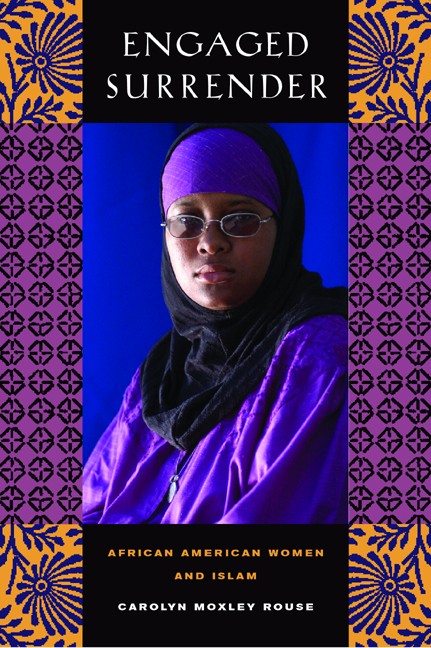
Commonly portrayed in the media as holding women in strict subordination and deference to men, Islam is nonetheless attracting numerous converts among African American women. Are these women "reproducing their oppression," as it might seem? Or does their adherence to the religion suggest unsuspected subtleties and complexities in the relation of women, especially black women, to Islam? Carolyn Rouse sought answers to these questions among the women of Sunni Muslim mosques in Los Angeles. Her richly textured study provides rare insight into the meaning of Islam for African American women; in particular, Rouse shows how the teachings of Islam give these women a sense of power and control over interpretations of gender, family, authority, and obligations.
In Engaged Surrender, Islam becomes a unique prism for clarifying the role of faith in contemporary black women's experience. Through these women's stories, Rouse reveals how commitment to Islam refracts complex processes—urbanization, political and social radicalization, and deindustrialization—that shape black lives generally, and black women's lives in particular. Rather than focusing on traditional (and deeply male) ideas of autonomy and supremacy, the book—and the community of women it depicts—emphasizes more holistic notions of collective obligation, personal humility, and commitment to overarching codes of conduct and belief. A much-needed corrective to media portraits of Islam and the misconceptions they engender, this engaged and engaging work offers an intimate, in-depth look into the vexed and interlocking issues of Islam, gender, and race.
In Engaged Surrender, Islam becomes a unique prism for clarifying the role of faith in contemporary black women's experience. Through these women's stories, Rouse reveals how commitment to Islam refracts complex processes—urbanization, political and social radicalization, and deindustrialization—that shape black lives generally, and black women's lives in particular. Rather than focusing on traditional (and deeply male) ideas of autonomy and supremacy, the book—and the community of women it depicts—emphasizes more holistic notions of collective obligation, personal humility, and commitment to overarching codes of conduct and belief. A much-needed corrective to media portraits of Islam and the misconceptions they engender, this engaged and engaging work offers an intimate, in-depth look into the vexed and interlocking issues of Islam, gender, and race.