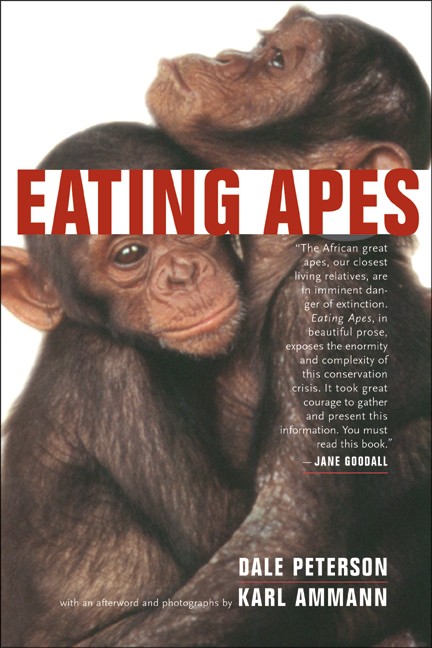
“Buy the book, read it, weep.” “Peterson is a remarkably graceful writer, considering his gruesome topic, and readers should be thankful.”
“Dale Peterson’s ugly, important new book is . . . an examination of the slaughter, for food, or humanity’s four closest primate relatives. . . . [Peterson] is an earnest advocate and careful researcher.”
“Eating Apes is a serious study. As unpleasant as it is, this is a story that must be told, and more important, a story that must be known.”
“Eating Apes is informative, clear, and precise on the nature and origins of the crisis... and if you never read a word of it, then at least stop to look at Karl Ammann’s photographs in the middle to see why this crisis should no longer be ignored.”
“Opens onto a broader indictment of institutional ‘feel-good conservation,’ which can bear any extinction save that of its donor base. But Peterson doesn’t stop at despair; he outlines reasonable measures governments and individuals can take, arguing that since apes constitute just 1 percent of Africa's fast-diminishing meat larder, they, at least, can be saved. All you need is the will, the money, and the unvarnished truth. One out of three is a start."
“Peterson deconstructs the complexity of the Central and West African bushmeat trade and its role in the destruction of the great apes. Eating Apes is by far his best work to date: It has breadth and depth; the writing is crisp, clear and engaging.”
“Peterson is a remarkably graceful writer, considering his inherentlygruesome topic, and readers should be thankful, for the only real way to grasp the enormity of the problem is to read this elegant book in its entirety.”
“Peterson is never shrill, and rarely does his tone become emotional; he does not overwhelm readers with evidence, yet his evidence is extensive. Ammann’s chilling photographs... contribute vastly to this equally distressing and thought-provoking survey.”
“The issues [in Eating Apes] are not only more complex; they are also both fascinating and... deeply disquieting. It is a tribute to this book, and no doubt a long-overdue reward to the man who inspired it, that it explains them so well.”
“This book, with its critical assessment of the wildlife trade, comes not a moment too soon and carries an important message.“
“Will shock even readers who felt they were will-informed on the plight of many wild animals.” “An interesting book, strange, shocking, unsettling and ambivalent.”
"A beautifully written book about an ongoing tragedy of global significance. Dale Peterson's account sweeps across broad issues of conservation and animal welfare that are linked to human welfare and should be the concern of everyone everywhere."—Edward O. Wilson, author of the Pulitzer Prize-winning On Human Nature
"I applaud Dale Peterson for taking on this challenging subject with courage and honesty. In identifying development, in the form of logging, as the primary threat to biodiversity in Africa, this book gets it right, and I recommend it most highly to anyone who wishes to be let in on the secrets of Africa's biggest conservation crisis."—Marcellin Agnagna, former Director of Wildlife and National Parks for the Republic of Congo
"The African Great Apes, our closest living relatives, are in imminent danger of extinction. Eating Apes, in beautiful prose, exposes the enormity and complexity of this conservation crisis. It took great courage to gather and present this information. You must read this book."—Jane Goodall
"It is with joy that I welcome this beautifully written and persuasive book that I pray should be read not only in America and Europe but also in Africa. We are facing an environmental crisis because of those few political and corporate opportunists who take advantage of weak political institutions lacking legitimacy for the indigenous peoples of Central and West Africa."—Ajume H. Wingo, Professor of Political Philosophy, University of Massachusetts, Boston, and Research Fellow of the W.E.B. DuBois Institute, Harvard University
"What is happening to our nearest relatives, the African great apes, in their last remaining strongholds, is appalling, yet most of us know nothing about it. We should all thank Dale Peterson and Karl Ammann for this powerful book, which should end that ignorance. Everyone should read it, and then insist that their governments act before it is too late."—Peter Singer, author of Animal Liberation and Ethics
"In Eating Apes, Dale Peterson becomes the Hercule Poirot of the tropics. When he heard that in the equatorial forests apes have become meat for loggers, Peterson set off to part the curtain on a world of jungle tragedy where cultures collide, where innocence is eroded by money and power, and where conservation all too often collapses into politics. What he found is shocking, but his detective work means that ignorance is no longer an excuse for the world's inaction. Will the apes survive? Eating Apes is a brilliant, intimate guide to the challenge--and a launching-pad for the rescue mission."—Richard Wrangham, author of Demonic Males: Apes and the Origins of Human Violence
"Peterson and Amman's book is a bold and brave j'accuse of the logging and conservation organizations who are spearheading this latest attack. You must read this book. And then you must follow the advice of Peterson and Amman as to what you can do to help stop it."—Roger Fouts, author of Next of Kin