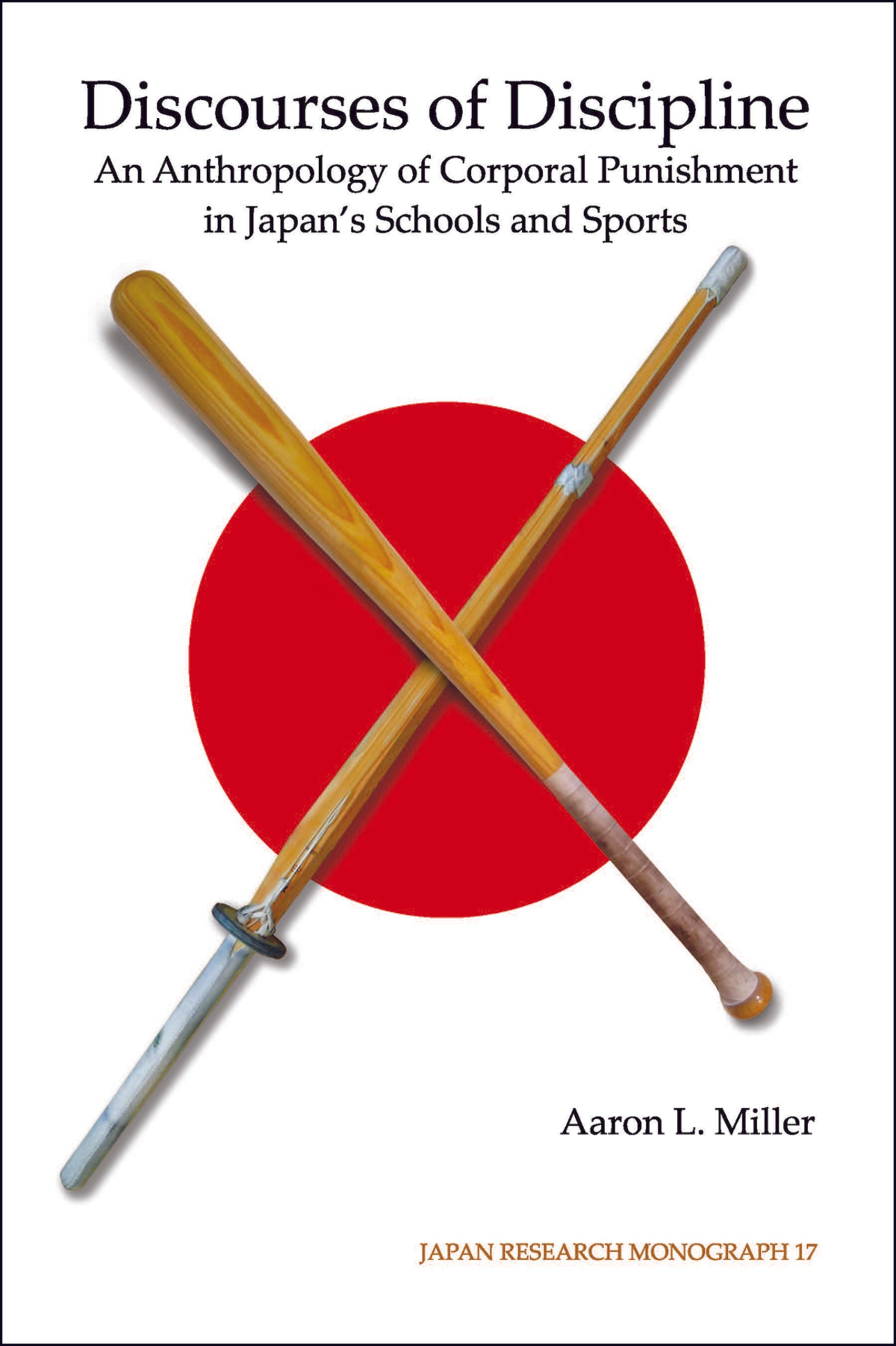
Discourses of Discipline
- Japan Research Monograph
About the Author
Table of Contents
Introduction – 1
Three Stories of Taibatsu
What Is Taibatsu?
Why We Should Study Taibatsu in Japanese Schools and Sports
Thesis and Chapter Summaries
1. Anthropology and Corporal Punishment – 31
Corporal Punishment (Research) Today
How Anthropology Can Help Us Better Understand Corporal Punishment
2. Histories – 47
"Taibatsu" Before the Term "Taibatsu" Existed
Prewar Legal Prohibitions of Taibatsu
Postwar Legal Prohibitions of Taibatsu
The Postwar Construction of Taibatsu as "Solution," "Problem," and "Non-Issue"
3. Contexts – 82
The Importance of Context
The Forms of Discipline
The Genders of Discipline
The Spaces of Discipline
The Inflictors of Discipline
The "Languages" of Discipline
4. Ethics – 98
Conflicting Sports and Classroom Pedagogies
Arguments of Right and Wrong
Arguments in Favor
Arguments Against
5. Purported Causes and Plural Cultures – 125
Causal Interpretations of Corporal Punishment Worldwide
Structural "Causes" of Taibatsu in Japanese Schools and Sports
Cultural "Causes" of Taibatsu in Japanese Schools and Sports
Beyond Culturalism
6. Discourses of Power and the Power of Discourse – 154
The Importance of Historical and Cross-Cultural Analysis
Theories of Power, Violence, and the Body
Silence, Words, and Actions: How Discourses of Discipline Are "Powerful" in Their Own Right
Epilogue – 164
Beyond the "Violent Culture" Myth
Appendices – 171
Bibliography – 203
Index – 235
Reviews
"An intriguing and well-written analysis on molding character in Japanese schools and sports through the widespread use of corporal punishment. Miller frames his discussion in the contexts of Japanese cultural ideals about discipline, toughness, and self-improvement, as well as in Japanese perceptions of such forms of discipline as something uniquely Japanese. This book is an important contribution to understanding the social and cultural dynamics of core institutions in contemporary Japan."—Theodore C. Bestor, Harvard University
"Corporal punishment as a discipline of pain and an abuse of adult authority is a troubling presence in Japanese classrooms and sports fields. This is an insightful and wide-ranging analysis that overturns simple judgments with a nuanced exploration of the historical development, sociocultural locations, and heated national discourse on corporal punishment in modern Japan. It is a significant contribution to our understanding of Japanese education and sports, and it is an original anthropological perspective on how we might theorize power in Japanese society."—William W. Kelly, Yale University
"[This book] present[s] a thorough contextualization and rethinking of the issue [of corporal punishment] and in doing so paves the way for others to find the answers....It would be essential reading for anyone interested in Japanese sport and, considering other issues and problems (bullying, school refusal, and drop-out) faced in Japanese education, a way of examining various problematic relationships of power. Finally this book exposes the culturalist shortcomings in explaining violence in a given society."—Brent McDonald, Victoria University, Pacific Affairs 88, no. 4 (December 2015): 932–934.
“This book adds nuance to corporal punishment research that has been long overdue and is a crucial addition to the Anthropologies of Young People, Education and Violence and should become essential reading for anyone—theorist or practitioner—working on questions concerning matters of discipline and punishment.”—Franziska Fay, School of Oriental and African Studies (SOAS), Children’s Geographies 15, no. 3 (2017): 381–383.
