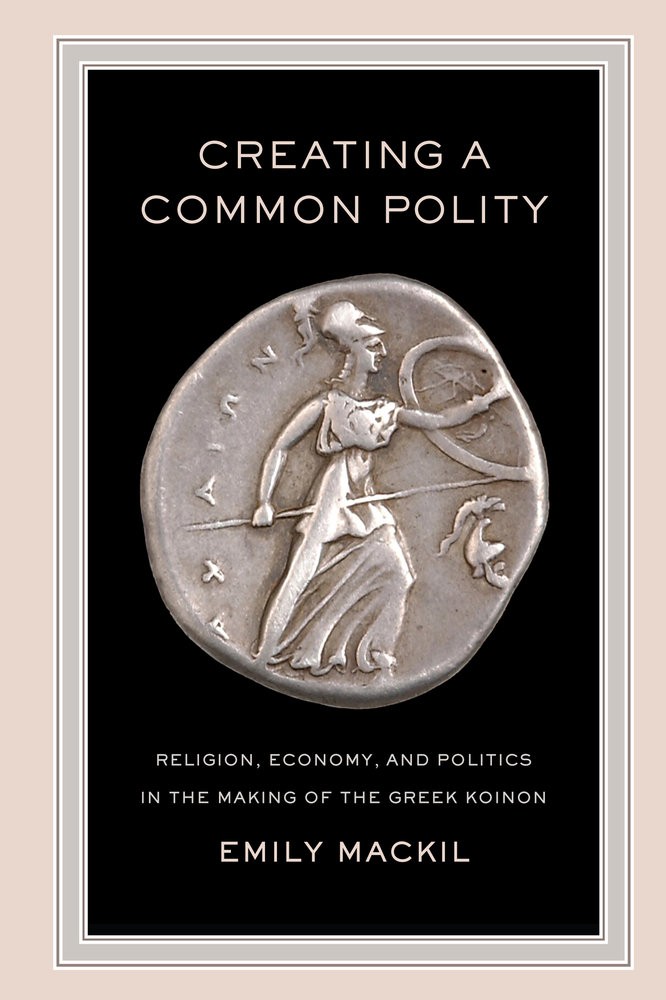
About the Book
In the ancient Greece of Pericles and Plato, the polis, or city-state, reigned supreme, but by the time of Alexander, nearly half of the mainland Greek city-states had surrendered part of their autonomy to join the larger political entities called koina. In the first book in fifty years to tackle the rise of these so-called Greek federal states, Emily Mackil charts a complex, fascinating map of how shared religious practices and long-standing economic interactions faciliated political cooperation and the emergence of a new kind of state. Mackil provides a detailed historical narrative spanning five centuries to contextualize her analyses, which focus on the three best-attested areas of mainland Greece—Boiotia, Achaia, and Aitolia. The analysis is supported by a dossier of Greek inscriptions, each text accompanied by an English translation and commentary.
Table of Contents
Preface
Abbreviations
Maps
Introduction
Strategies Old and New
Institutions
An Example
A Road Map
Part I. Cooperation, Competition, and Coercion: A Narrative History
1. The Archaic Period and the Fifth Century
Boiotia
Achaia
Aitolia
2. The Fourth Century
Common Wars, Common Peaces, Common Polities, 404–371
Theban Hegemony and the Hegemony of the Koinon, 371–346
A New Macedonian Order, 346–323
3. The Hellenistic Period
Mainland Greece and the Wars of the Successors, 323–285
Independence and Expansion, 284–245
Shifting Alliances, 245–229
The Roman Entrance and the War against Kleomenes, 229–222
The Rise of Philip V and the Social War, 221–217
The First and Second Macedonian Wars: Rome, Aitolia, and Philip V, 215–196
The Freedom of the Greeks and the Dismantling of Regional Cooperation, 196–167
Bargaining with Rome, the Struggle for Sparta, and the End of the Achaian Koinon, 167–146
Part II. Interactions and Institutions
4. Cultic Communities
Building Regional Communities
Politicizing Regional Communities
Legitimating and Celebrating the Power of the Koinon
Reproducing the Power of the Koinon
5. Economic Communities
Cooperative Coinage and Early Forms of Economic Cooperation
Protecting and Promoting Economic Mobility
Resource Complementarity and Economic Interdependence
Winning the Battle for Resources
Taxation and Regional State Revenues
Managing Economic Crises and Disputes
6. Political Communities
Coercion and Cooperation in the Formation of the Koinon
The Terms of the Federal Compromise
Enforcement, Negotiation, and Institutional Stability
Conclusion
Appendix: Epigraphic Dossier
I. Boiotia: T1–T33
II. Achaia: T34–T46
III. Aitolia: T47–T61
Bibliography
Index