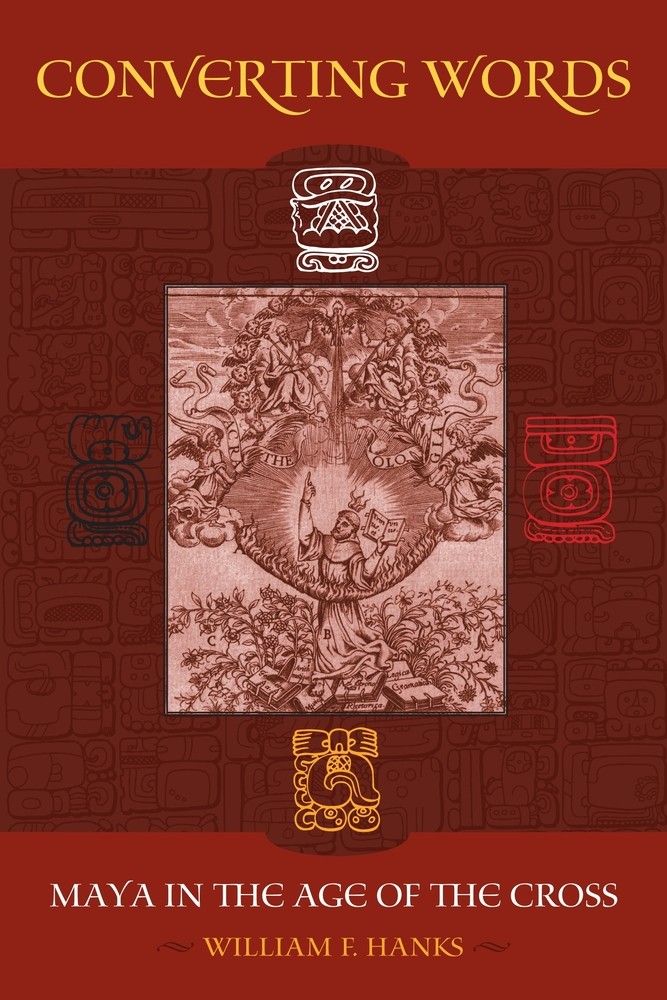
About the Book
This pathbreaking synthesis of history, anthropology, and linguistics gives an unprecedented view of the first two hundred years of the Spanish colonization of the Yucatec Maya. Drawing on an extraordinary range and depth of sources, William F. Hanks documents for the first time the crucial role played by language in cultural conquest: how colonial Mayan emerged in the age of the cross, how it was taken up by native writers to become the language of indigenous literature, and how it ultimately became the language of rebellion against the system that produced it. Converting Words includes original analyses of the linguistic practices of both missionaries and Mayas-as found in bilingual dictionaries, grammars, catechisms, land documents, native chronicles, petitions, and the forbidden Maya Books of Chilam Balam. Lucidly written and vividly detailed, this important work presents a new approach to the study of religious and cultural conversion that will illuminate the history of Latin America and beyond, and will be essential reading across disciplinary boundaries.
Table of Contents
List of Illustrations
List of Tables
Preface
Acknowledgments
1. Introduction: The Field of Discourse Production
The Making of a Translanguage • The Body as Totality •
A Shifting Voice for Indian Authors
Part I. The Scope of Reduccíon
2. Perpetual Reducción in a Land of Frontiers
Notes on the Political Geography of Post-Mayapán Yucatán •
López Medel and the Spirit of the Laws • Reducción in a Regional
Perspective • A Land of Frontiers
3. To Make Themselves New Men
Governance of the Guardianía • Disciplining the Senses •
Bishop Toral’s Vision • Cogolludo’s Landscape • Guardianía
and Cofradía • Cabildos in the Mission Towns
Part II. Converting Words
4. From Field to Genre and Habitus
Metalinguistic Labeling • Production Format and Author
Position • I ndexical Centering in the Deictic Field •
Stylistic Differentiation of Genres • Multimodality:
Speech, Animation, Inscription • Iteration
5. First Words: From Spanish into Maya
Dictionaries and the Problem of Authorship • The Thematic
Scope of the Dictionaries • From Spanish into Maya •
First Principles • R eligious Practices • Pedagogy •
Language and Signs • G overnance • Marginal Practices
6. Commensuration: Maya as a Matrix Language
Commensuration and Translingual Meaning • Fray Antonio
de Ciudad Real, Exemplary Lengua
7. The Grammar of Reducción and the Art of Speaking
What Is an Arte? • The Shadow of Nebrija • Fray Juan Coronel, Arte
en lengua de maya (1620) • G abriel de San Buenaventura, Arte de la
lengua maya (1684) • Fray Pedro Beltrán de Santa Rosa María, Arte de
el Idioma Maya (1746) • Missionary Linguistics as a Hybrid System
8. The Canonical Word
The Maya Doctrinas • What Is a Doctrina Menor? praying in
maya / doctrinal dialogues / sermons
Part III. Into the Breach: The Dispersion of Maya reducido
9. The Scripted Landscape
What Is a Notarial Document? • L andscape as Text • Early
Chronicles • The Titles of Ebtun • Bills of Sale
10. Petitions as Prayers in the Field of Reducción
Letters of the Caciques to the Crown, February 11, 1567 • L etter of
the Batabs to the Crown, March 19, 1567 • Petition from Dzaptún,
July 20, 1605 • Petitions from Numkiní and Xecelchakán,
November 1669
11. Cross Talk in the Books of Chilam Balam
Doctrinal Language in the Books of Chilam Balam • True God
Comes to Yucatán • The Sadness of the Christians • The Words
of the Prophet
Epilogue: Full Circle
Notes
References Cited
Index