University of California Press

About the Book

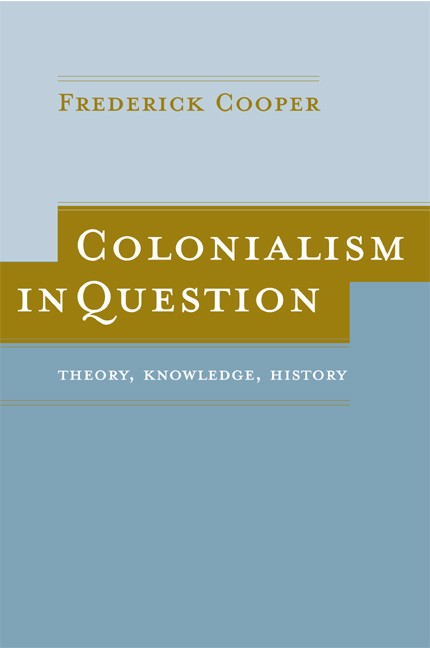
In this closely integrated collection of essays on colonialism in world history, Frederick Cooper raises crucial questions about concepts relevant to a wide range of issues in the social sciences and humanities, including identity, globalization, and modernity. Rather than portray the past two centuries as the inevitable movement from empire to nation-state, Cooper places nationalism within a much wider range of imperial and diasporic imaginations, of rulers and ruled alike, well into the twentieth century. He addresses both the insights and the blind spots of colonial studies in an effort to get beyond the tendency in the field to focus on a generic colonialism located sometime between 1492 and the 1960s and somewhere in the "West." Broad-ranging, cogently argued, and with a historical focus that moves from Africa to South Asia to Europe, these essays, most published here for the first time, propose a fuller engagement in the give-and-take of history, not least in the ways in which concepts usually attributed to Western universalism—including citizenship and equality—were defined and reconfigured by political mobilizations in colonial contexts.

About the Author

Frederick Cooper, Professor of History at New York University, is author of Africa since 1940: The Past of the Present (2002) and coeditor, with Ann Laura Stoler, of Tensions of Empire: Colonial Cultures in a Bourgeois World (California, 1997), among other books.

Table of Contents

List of Illustrations
Acknowledgments

PART I. COLONIAL STUDIES AND INTERDISCIPLINARY SCHOLARSHIP
1. Introduction: Colonial Questions, Historical Trajectories
2. The Rise, Fall, and Rise of Colonial Studies, 1951–2001

PART II. CONCEPTS IN QUESTION
3. Identity—With Rogers Brubaker
4. Globalization
5. Modernity

PART III. THE POSSIBILITIES OF HISTORY
6. States, Empires, and Political Imagination
7. Labor, Politics, and the End of Empire in French Africa
8. Conclusion: Colonialism, History, Politics

Notes
Index

Reviews

“A must read for all students and scholars of Africa, colonialism, and social theory more generally.”
Intl Journal Of African Historical Stds
“In the ongoing theoretical debate about the West’s impact on the rest of the world, Frederick Cooper brings a fresh and independent perspective in this important collection of essays.” “The result is a refreshingly astringent, analytically rigorous work that should be read by anyone interested in the current state of play in this contentious field of study.”
The International History Review
“Makes essential points about theoretical clarity, and it is worth the price of the book. . . . It should be required reading for graduate historiography and seminars in comparative history / comparative empires. . . . Scholars will be as impressed and enlightened by Cooper’s navigation of substantive and nuanced debates, as they will be inspired to pick up the arguments in his many controversial points.”
Journal Of Colonial & Colonialism History
"Probably the most important historian of Africa currently writing in the English language. His intellectual reach and ambition have even taken influence far beyond African studies as such, and he has become one of the major voices contributing to debates over empire, colonialism and their aftermaths. This book is a call to reinvigorate the critical way in which history can be written. Cooper takes on many of the standard beliefs passing as postcolonial theory and breathes fresh air onto them."—Michael Watts, Director of the Institute of International Studies, Berkeley

"This is a very much needed book: on Africa, on intellectual artisanship and on engagement in emancipatory projects. Drawing on his enormous erudition in colonial history, Cooper brings together an intellectual and a moral-political argument against a series of linked developments that privilege 'taking a stance' and in favor of studying processes of struggle through engaged scholarship."—Jane I. Guyer, author of Marginal Gains