University of California Press

About the Book

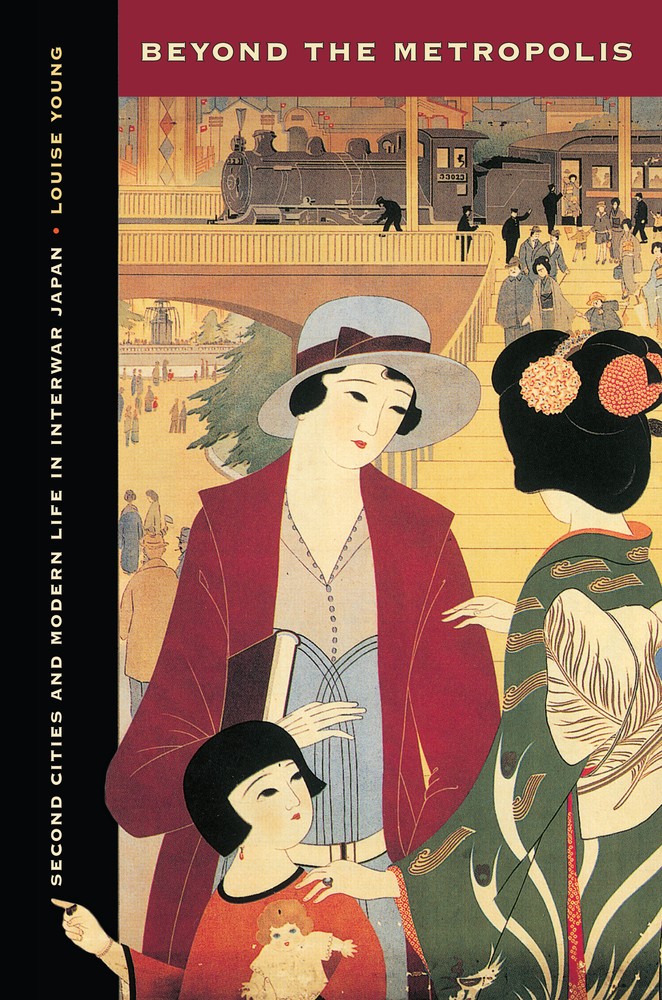
In Beyond the Metropolis, Louise Young looks at the emergence of urbanism in the interwar period, a global moment when the material and ideological structures that constitute “the city” took their characteristic modern shape. In Japan, as elsewhere, cities became the staging ground for wide ranging social, cultural, economic, and political transformations. The rise of social problems, the formation of a consumer marketplace, the proliferation of streetcars and streetcar suburbs, and the cascade of investments in urban development reinvented the city as both socio-spatial form and set of ideas. Young tells this story through the optic of the provincial city, examining four second-tier cities: Sapporo, Kanazawa, Niigata, and Okayama. As prefectural capitals, these cities constituted centers of their respective regions. All four grew at an enormous rate in the interwar decades, much as the metropolitan giants did. In spite of their commonalities, local conditions meant that policies of national development and the vagaries of the business cycle affected individual cities in diverse ways. As their differences reveal, there is no single master narrative of twentieth century modernization. By engaging urban culture beyond the metropolis, this study shows that Japanese modernity was not made in Tokyo and exported to the provinces, but rather co-constituted through the circulation and exchange of people and ideas throughout the country and beyond.

About the Author

Louise Young is Professor of History at the University of Wisconsin-Madison and author of Japan’s Total Empire: Manchuria and the Culture of Wartime Imperialism (UC Press, 1998).

Table of Contents

Acknowledgments

Part One. Contexts
Introduction: Urbanism and Japanese Modern
1. World War One and the City Idea
Part Two. Geo-Power and Urban-Centrism
2. The Ideology of the Metropolis
3. Colonizing the Country
Part Three. Modern Times and the City Idea
4. The Past in the Present
5. The Cult of the New

Epilogue: Urbanism and Twentieth-Century Japan

Notes
Bibliography
Index

Reviews

"[A] fascinating and wide-ranging study. . . .  An enlightening message."
The Times Literary Supplement
"Young's deeply layered work combining cultural and urban history is a remarkable achievement."
American Historical Review
"Stimulating... finely argued."
Journal of Japanese Studies
"Through clearly formulated and detaield discussions... [Young's] line of argument takes [her] to the edges of profound and highly contested dynamics in the historiography of twentieth-century Japan... illuminating work..."
Pacific Affairs Book Review
"Beyond the Metropolis offers the most thought-provoking and consequential treatment of Japanese urbanism in well over a decade."
Monumenta Nipponica
"[Young] lays bare the urban-centrism of the modern age—the idea that the Japan’s destiny would be determined by the health of its cities—and shows it to be a co-production of citizens in second cities and the metropolitan core. Along the way she enriches our understanding of social class as well as regionalism. The ideas and practices of the city introduced in this book continue to define Japan to this day."—Andrew Gordon, Harvard University

"...An excellent, original [book] based on extensive research in Japanese primary and secondary sources. Young issues a powerful corrective to mainstream scholarship, which has long offered a narrative of nationwide modern developments in Japan based on the centralizing impulses of Tokyo-based culture and the bureaucratic state located in Tokyo... I strongly recommend [this book]."—Sheldon Garon, author of Molding Japanese Minds: The State in Everyday Life