University of California Press

About the Book

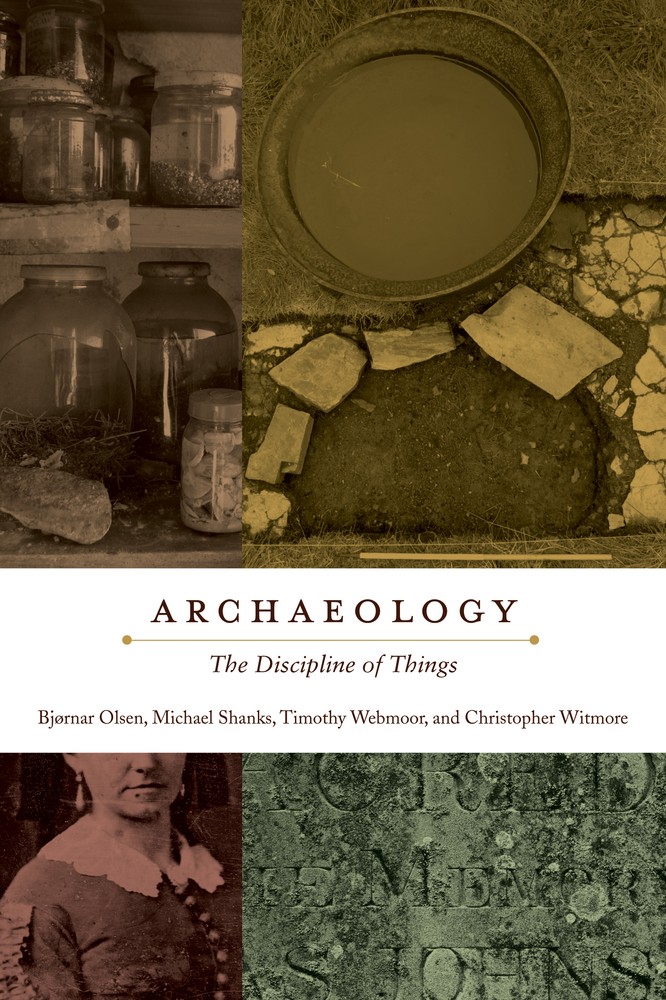
Archaeology has always been marked by its particular care, obligation, and loyalty to things. While archaeologists may not share similar perspectives or practices, they find common ground in their concern for objects monumental and mundane. This book considers the myriad ways that archaeologists engage with things in order to craft stories, both big and small, concerning our relations with materials and the nature of the past.

Literally the “science of old things,” archaeology does not discover the past as it was but must work with what remains. Such work involves the tangible mediation of past and present, of people and their cultural fabric, for things cannot be separated from society. Things are us. This book does not set forth a sweeping new theory. It does not seek to transform the discipline of archaeology. Rather, it aims to understand precisely what archaeologists do and to urge practitioners toward a renewed focus on and care for things.

About the Author

Bjørnar Olsen, Professor at the Institute of Archaeology at the University of Tromso.

Michael Shanks is Omar and Althea Hoskins Professor of Classics at Stanford.

Timothy Webmoor is Research Fellow in Science and Technology Studies at the Institute for Science, Innovation and Society at the University of Oxford.

Christopher Witmore is Associate Professor with the Department of Classical & Modern Languages & Literatures at Texas Tech University.

Table of Contents

Preface
1. Introduction: Caring about Things
2. The Ambiguity of Things: Contempt and Desire
3. Engagements with Things: The Making of Archaeology
4. Digging Deep: Archaeology and Excavation
5. Things in Translation: Documents and Imagery
6. Futures for Things: Memory Practices and Digital Translation
7. Timely Things: From Argos to Mycenae and Beyond
8. Making and the Design of Things: Human Being and the Shape of History
9. Getting on with Things: A Material Metaphysics of Care
References
Index

Reviews

“Illuminating. . . . This book will make students more aware . . . and travelers to ruins more sensitive to what is highlighted and what is ignored, although present. . . . Recommended.”
Choice
"The messages found in The Discipline of Things should resonate across the fields of anthropology, archaeology, and material culture studies, attracting readers ranging from traditional material culture researchers to those with a postprocessualist tendency."
American Journal of Archaeology
"Genuinely thoughtful about the nature (or natures) of archaeology . . . refreshingly original."
Journal of Anthropological Research
"Fascinating . . . provides a good overview of [human-thing relationship] debates and reminds us that we overlook the thingly character of the discipline to our detriment."
Archaeological Journal
“This book exhorts the reader to embrace the materiality of archaeology by recognizing how every step in the discipline’s scientific processes involves interaction with myriad physical artifacts, ranging from the camel-hair brush to profile drawings to virtual reality imaging. At the same time, the reader is taken on a phenomenological journey into various pasts, immersed in the lives of peoples from other times, compelled to engage their senses with the sights, smells, and noises of the publics and places whose remains they study. This is a refreshingly original and provocative look at the meaning of the material culture that lies at the foundation of the archaeological discipline.”—Michael Brian Schiffer, author of The Material Life of Human Beings

“This volume is a radical call to fundamentally rethink the ontology, profession, and practice of archaeology. The authors present a closely reasoned, epistemologically sound argument for why archaeology should be considered the discipline of things, rather than its more commonplace definition as the study of the human past through material traces. All scholars and students of archaeology will need to read and contemplate this thought-provoking book.”—Wendy Ashmore, Professor of Anthropology, UC Riverside

"A broad, illuminating, and well-researched overview of theoretical problems pertaining to archaeology. The authors make a calm defense of the role of objects against tedious claims of 'fetishism.'"—Graham Harman, author of The Quadruple Object