University of California Press
Publishing Services

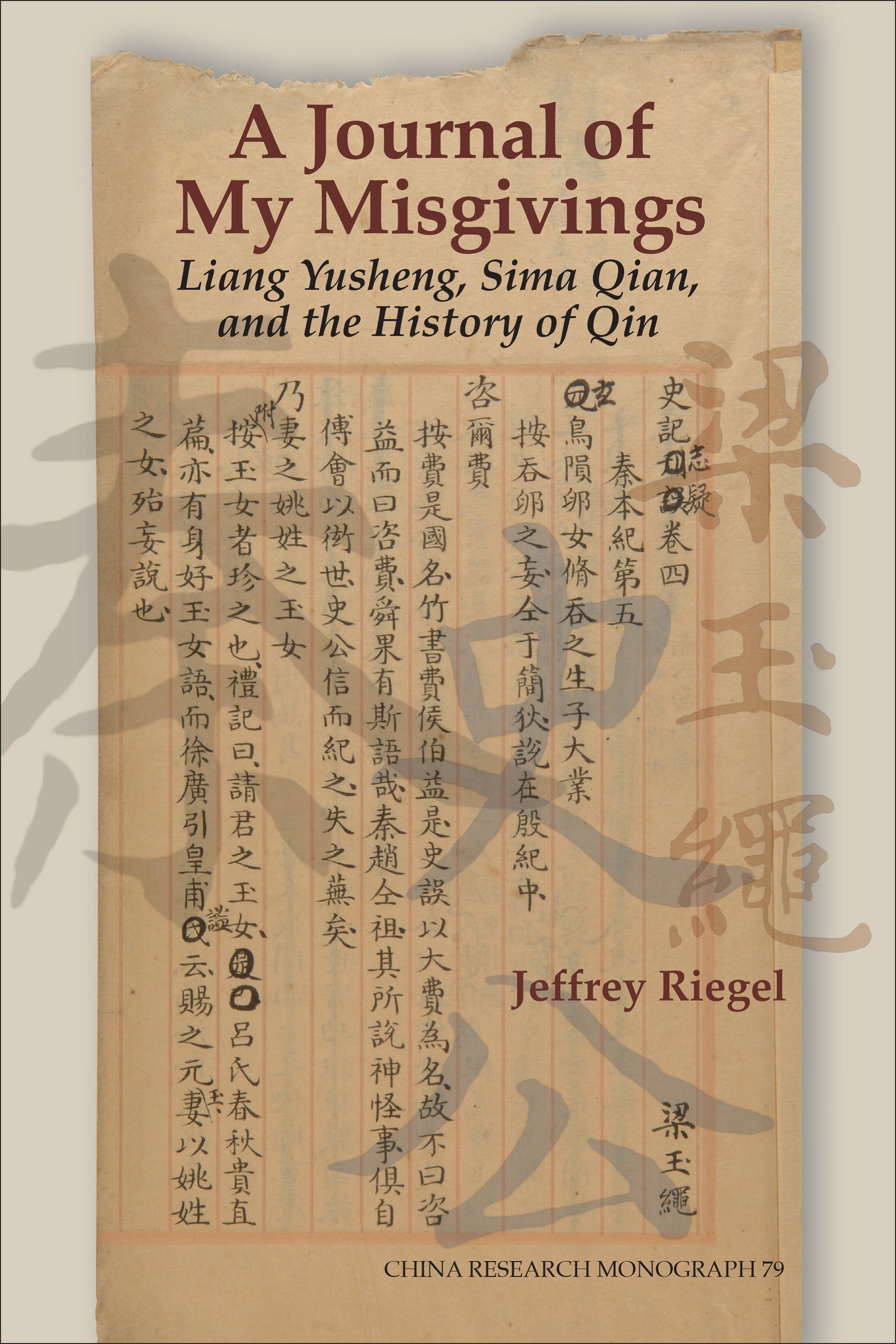
A Journal of My Misgivings

Liang Yusheng, Sima Qian, and the History of Qin

by Jeffrey Riegel (Author)
Price: $45.00 / £38.00
Publication Date: Aug 2023
Publisher:
Institute of East Asian Studies, University of California Berkeley
Imprint: Institute of East Asian Studies, University of California Berkeley
Title Details:
Rights: World
Pages: 576
ISBN: 9781557292032
Trim Size: 6 x 9
Series:
  • China Research Monograph

About the Book

A Journal of My Misgivings about the Records of the Grand Historian (Shiji zhiyi ????), written by Liang Yusheng ??? (1745–1819), is a detailed analysis and critique of the Shiji ?? of Sima Qian ??? (b. 145 BCE). Sima Qian had composed a masterful survey of the ancient dynasties and ruling houses from legendary times until the second century BCE, and filled it with anecdotes, short biographies, lineages, legends, and learned treatises as well as his own observations and opinions.  
 
Because the scope of Liang’s Journal is as broad and complex as the Shiji, Jeffrey Riegel’s study of it focuses on Liang’s critiques of those parts of the Grand Historian’s Records relating to the slow rise and precipitous fall of Qin, weaving Liang’s scholarship into a revision of Sima Qian’s narration of the five-hundred-year transformation of Qin from marginal state to hegemonic power. Riegel first provides an account of Liang’s life in Qing dynasty Hangzhou and a study of his methodology and sources before turning to revisions of what the Shiji says about Qin’s origins, the state’s ruling lineage, and its later kings and emperors, as well as the geography of the Qin state and empire, and the almost countless battles from which Qin emerged as ultimate victor in 221 BCE. The foundation of Riegel’s revisions to Qin history is the Shiji zhiyi, but on occasion Riegel supplements, corrects, and updates Liang’s scholarship by referring to the numerous archaeological discoveries that have dramatically altered our understanding of what happened in the history of early China. An appendix to the volume summarizes Liang’s valuable studies of early Chinese chronology. Other appendixes (that appear in an online supplement) provide further details on Liang’s corrections to Sima Qian’s text and include a Finding List of the relevant Shiji passages on the Qin, Liang’s scholarship, and other commentaries and translations. Errata, addenda, and an online supplement are available through the publisher.

About the Author

Jeffrey Riegel is professor emeritus of East Asian Languages and Cultures at the University of California, Berkeley. He is also professor emeritus of the School of Languages and Cultures at the University of Sydney. His research focuses on classical Chinese literature and early Chinese texts. He has studied and translated the Annals of Lü Buwei and Mozi. Education: M.A., Chinese, Stanford University; Ph.D., Chinese, Stanford University

Table of Contents

Preface ix
Abbreviations, Maps, Tables, and Technical Notes xv
I. Liang Yusheng and the Composition of A Journal of My Misgivings
1 The Life and Legacy of Liang Yusheng 
2 The Methods and Sources of an Eighteenth-Century Historian 
II: Qin History Revised
3 The Founders of the Qin Ruling Lineage and Their Heirs 
4 Kings and Emperors 
5 The Cultural and Administrative Geography of Qin 
6 Warfare 
Liang Yusheng on Shiji Chronology 
Epilogue: Liang Yusheng and the Shiji 
Bibliography 
Index 

ONLINE SUPPLEMENT
http://ieas.berkeley.edu/publications/crm79.html
Appendixes and Tables
1. Liang Yusheng’s Notes on the Guo Qin lun of Jia Yi
2. Textual Criticism and the Making of the Zhonghua shuju Edition of the Shiji
Finding List

Reviews

“The chapters in Sima Qian’s Shiji (Records of the Grand Historian) that relate to the history of Qin are unique and unequalled historical materials; and yet, because of an extreme lack of corroborating evidence, doubts about their reliability have arisen. In A Journal of My Misgivings, Jeffrey Riegel has with special discernment chosen such doubtful Shiji passages in order to examine the scholarly approach and contributions of the Shiji zhiyi [Liang Yusheng’s 18th-century criticism of Sima Qian’s work]. Professor Riegel on the one hand both describes in broad strokes the intellectual movements of the Qing dynasty as well as deeply explores the resources Liang Yusheng relied on and the distinctive features of his life. On the other hand, he absorbs the results from the latest archaeological discoveries and research on unearthed documents and judges with precision the successes and failures of Liang's work. Professor Riegel pertinently points out that Liang Yusheng’s revision of the text of the Shiji was deeply influenced by the research methodology prevalent during the Qianlong and Jiaqing reign periods of the Qing and that Liang’s forthright criticism of Sima Qian adopted the stricter historical standards of its “truth-seeking,” although sometimes Liang was not immune from the influence of his own biases. Through meticulous philological work, Professor Riegel’s book makes readers aware of the extent to which the Shiji zhiyi has influenced the current popular editions of the Shiji (and the appendix provided online lists one by one the corrections made by the Zhonghua shuju editors based on Liang Yusheng's textual notations). Professor Riegel proves that no matter whether one studies the Shiji or the historical periods it covers, one cannot avoid Liang Yusheng, though his work has in the past been slighted and disregarded. Just as Liang Yusheng “performed outstanding service” to Sima Qian so has Jeffrey Riegel “performed outstanding service” to Liang Yusheng. He has contributed to the academic world a book that must be consulted when reading the Shiji zhiyi and the Shiji, or when studying the history of Qin. For the sinological community, this book is equally as important as Liang’s original (or perhaps even more so).”—[translated] by Chen Kanli ???, Professor of History, Peking University

“Jeffrey Riegel’s monumental work on the Qing historian Liang Yusheng ??? (1745–1819) is the first book-length study of a single work of Qing kaozheng ?? scholarship published in any Western language.... While the first part describes the historian in a general sense, the second one deals with concrete issues of Qin history. There, Riegel shows in great detail the methods that Liang Yusheng used in order to correct what he perceived as errors in Sima Qian’s text.... Riegel masterly presents us with the traditional history of the Qin dynasty as well as with the many elements that we have come to know about it due to archeological discoveries in more recent times.”—Hans van Ess, Ludwig Maximilians-Universität, München, T’oung Pao 110 (2024): 487–518.

"Having devoted decades to Liang Yusheng, Riegel, in compiling this large and densely written volume, intimately recreates the practice of a Qing evidence scholar. But in the end, his reenactment is not a simple replica, but a close-up case study of Qing scholarship—one that not only reconstructs its content, but also reveals the context in which it was created and situated. As a result, Riegel makes a unique and valuable contribution to the field of Qing intellectual history in any language."—Q. Edward Wang, Rowan University, Journal of Chinese History (2025), 1–3